Showing posts with label Sedan. Show all posts

Monday, September 13, 2010

Volkswagen CC Sport Review


I wonder if Volkswagen appreciates the irony of the new CC.


Six years ago, the company introduced the Phaeton, a big luxury sedan with a price tag starting around $65,000 and running all the way up to $95,000 (a hundred grand with tax) for a 12-cylinder model.


It was a monumental flop, yanked summarily from the U.S. market after only a couple of seasons (it is still sold in Europe and is on the verge of a third facelift for 2011 that has die-hard fans hoping for a return to America)


Part of the problem was that for all that money, it looked like a Passat, only bigger. And from a block away, with no perspective to judge size, it looked like a Passat, period.


So now, VW creates a truly desirable car...and it really is a Passat...but with a sleek roofline and some other styling tricks.


And...here's the good part...it carries a price tag lower than the Passat...base price for the Sport model I drove is $27,100...$1,200 below the least-expensive Passat.


The current-generation Passat is a bit of an awkward child...not Teutonically purposeful as the ones before, but without actually achieving elegance or desirability. Attempts to soften the Passat have resulted in it coming off as lukewarm.


But the CC turns up the heat by appealing to the emotions with fluid, sensuous lines.


And the best part is that, through artful use of colors, details and materials, Volkswagen makes the CC's interior feel special, too...giving you the impression that you're driving something a rung or two above the Passat.


The CC gets these impressions so right that driving the base model (the Sport), with only two options (a six-speed automatic transmission and Sirius Satellite radio), feels like the lap of luxury...and keeps the price tag, including destination charges, under $30,000.


You can go hog-wild with the VR6 4Motion and break $40,000 without a sweat....but why, when the Sport is so good?


EPA estimate (with automatic): 19 city/29 highway. Manual transmission 21 city/31 highway.


UPDATE: Just ended a week in another CC Sport (courtesy Camelback Volkswagen in Phoenix). Everything above applies...apart from a base price increase to $27,760. Still, this one bottom-lined at $29,660...with the only option being a six-speed automatic.


And about that...the gas mileage estimate improves to 22 city/31 highway. In my even mix of city streets and freeways, I got 24 for the week...and the range estimate when I took delivery of 450 miles seems plausible. I handed it back this morning with just under half a tank of gas remaining.

Saturday, September 11, 2010

Subaru Legacy 2.5 i and 3.6R Limited Review


Subaru has made its place in the automotive world the past 35 years or so by being the Japanese SAAB. Quirky, yet loveable...attracting a small but devoted following.


Attempting to go mainstream is part of what very nearly killed SAAB, so there's precedent for concern every time Subaru gets a bit more normal.


Except that Subaru's managed it quite well...first with the Outback, then the Forester, and now with the Legacy.


The Legacy is stepping up in size and refinement, becoming for the first time a logical and direct alternative to Honda Accord and Toyota Camry.


And to show just how good the basic product is, Subaru sent us a no-frills Legacy 2.5i. Not a single option (but with 17-inch alloy wheels, 4-wheel anti-lock disc brakes, air conditioning, AM/FM/CD, an auxilary audio jack, XM/Sirius capability, a multifunction trip computer, an outside temperature gauge, cruise control, tilt/telescoping steering wheel, power windows, door locks and mirrors, a remote keyless entry system, and map and courtesy lights all standard, it's a complete package without any options).


Even though the Legacy is bigger now, it's lighter than the competition...handles better...and don't forget...it's a Subaru, so all-wheel drive is part of the deal.

And the power from the 2.5 liter engine (170 horsepower), teamed with a smooth 6-speed manual, is more than adequate.


That six-speed is a help for the fuel economy...the EPA says 19 city, 27 highway.


And the price?


Well, the price had me reminding myself to think Subaru for my next family sedan: $19,995.


Remember the deal about no options? That's right...apart from $695 delivery charge, $19,995 is the base and the bottom line. There's a Camry a few hundred bucks cheaper, but not as satisfying, and the least-expensive Accord is $21,055. That's compelling math for a car that no longer has to be explained. The Legacy has arrived.


Japanese TV viewers got this commerical, with Robert DeNiro at the wheel of the new Legacy:


UPDATE: I chose to repeat the above review because the base Subaru Legacy is just so darn good.  But recently, I had a week in the top-of-the-line 2011 Subaru Legacy 3.6R Limited.  And it, too was a revelation...just for different reasons.


Regular TireKicker readers know that I believe you can too easily goop up a good car with add-ons and lose the basic flavor. But Subaru swings for the bleachers with the 3.6R Limited and hits a home run.


First of all, the engine....the 170 horses of the base car jumps to 256 in all three flavors of the R (R, R Premium and R Limited)...which puts the performance of the Legacy into another league entirely. The six-speed manual gets swapped for a five-speed automatic, but the extra power, the lack of a clutch and one fewer gear end up extracting the smallest penalty...18 city, 25 highway (as opposed to 19/27 for the base model).


And then, the creature comforts: Dual-zone automatic climate control, Bluetooth, a 440-watt Harmon Kardon 9-speaker audio system, leather-trimmed seats (including a 10-way power adjustable driver's seat and a 4-way power adjustable one for the front passenger)....all standard. In fact, the only option on our car was a power moonroof ($995)...running the base price of $28,295 to an as-tested (with $725 delivery charge) $30,015.


There are absolute bargains. The 2.5i is that. There's no other way to describe that much car for under $20,000.


And then there are bargains based on the comparison of content and price. And that's where, for a shade more than 8 grand more, the 3.6 R Limited earns its bargain status. Subaru has built a car that can run with a significantly pricier pack..and, as with the 2.5i, if it were my money...it would be an immediate contender.

Monday, August 30, 2010

2011 Infiniti G25 Sedan - Offers an Impressive Array of Luxury Features

2011 Infiniti G25 Sedan
Infiniti has announced 2011 Infiniti G25 Sedan at the Pebble Beach Concours d'Elegance . The 2011 Infiniti G25 Sedan is powered by a 2.5-liter DOHC 24-valve V6, 218 hp and 187 lb-ft of torque-driven development. The 2011 Infiniti G25 Sedan is equipped with a 7-speed automatic transmission and will be sold in two versions - with all-wheel drive and rear drive.

The 2011 Infiniti G25 Sedan is available in three trim levels: Base, Journey and G25x AWD Sedan, and will come with a wide range of devices. The 2011 Infiniti G25 Sedan equipment includes automatic climate control, premium audio system with six speakers, XM satellite radio and leather seats.

The 2011 Infiniti G25 Sedan comes standard with ABS, Vehicle Dynamic Control (VDC) and traction control system (TCS), xenon headlights and alloy wheels of 17 inches. The 2011 Infiniti G25 Sedan prices start at $ 30,950 when the new model goes on sale in September this year.

2011 Infiniti G25 Sedan Photos:
2011 Infiniti G25 Sedan 12011 Infiniti G25 Sedan2011 Infiniti G25 Sedan 3

Infiniti Press Release:

Infiniti today announced a new addition to the popular Infiniti G Line, the Infiniti G25 Sedan, which features a 2.5-liter V6 engine. It is scheduled to go on sale at Infiniti retailers nationwide in September, joining the Infiniti G37 Sedan, G37 Coupe and G37 Convertible. It will have a starting Manufacturer’s Suggested Retail Price* (MSRP) of $30,950 USD.


“With the new Infiniti G25 Sedan, we’re broadening the appeal of the G Line with a model designed to provide an additional choice for buyers looking for a true luxury sedan, but who might not need the higher levels of performance provided by our larger engine-equipped G37 models,” said Infiniti Vice President Ben Poore, speaking at a media event at the 60th annual Pebble Beach Concours d’Elegance. “The G25 is positioned in the heart of the luxury sport sedan market, allowing us to bring Infiniti’s Inspired Performance to a wider selection of buyers.”


The new 2011 Infiniti G25 Sedan shares the same dynamic exterior, interior and chassis as the G37, but with a smaller displacement engine. The 2.5-liter DOHC 24-valve V6 produces 218 horsepower and 187 lb-ft of torque, versus the G37’s 3.7-liter DOHC 24-valve V6’s 328 horsepower and 269 lb-ft of torque. The Infiniti G25 Sedan comes with a standard 7-speed automatic transmission and is available in both rear-wheel drive and intelligent all-wheel drive. Three models are offered: Infiniti G25 Sedan, Infiniti G25 Sedan Journey and G25x Sedan AWD.


The Infiniti G25 Sedan’s extensive list of standard equipment includes leather-appointed seating, Shodo aluminum interior trim, 8-way power driver’s seat and 4-way power front passenger’s seat, Automatic Temperature Control, premium audio system with six speakers, XM® Satellite Radio (XM® subscription required, sold separately) and much more.


Other standard features range from 17-inch aluminum-alloy wheels, High Intensity Discharge (HID) Xenon headlights, 4-wheel Anti-lock Disc Braking System (ABS), Vehicle Dynamic Control (VDC) and Traction Control System (TCS). The G25 Journey model adds RearView Monitor, heated front seats, heated outside mirrors, auto on/off headlights, Dual Zone Automatic Temperature Control and more.


“While the Infiniti G25 Sedan serves as the entry into the G line, it still offers an impressive array of luxury features – from leather-appointed seats to satellite radio,” said Poore. 

“With inspired style and performance – backed by our unique customer care philosophy, the Infiniti Total Ownership Experience® – we are confident the new G25 will attract a lot of attention in the marketplace.”

Wednesday, August 26, 2009

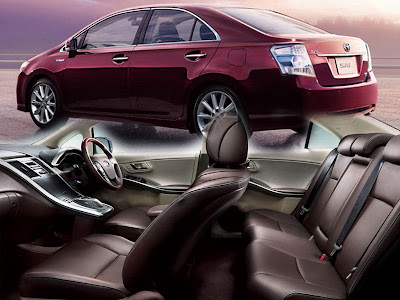
2010 Toyota SAI Hybrid Sedan a redesign of the Lexus HS250 hybrid


Toyota Motor Corp will be releasing a new petrol electric hybrid in Japan while the Prius will compete with Hyundai Motor Co in Korea. Toyota hopes to sell 36,000 of its new Sai hybrid sedan, Toyota’s goal being one million hybrid cars a year globally after 2010.
The Sai is Toyota’s second hybrid-only car, this car is a redesign of the Lexus HS250 hybrid. The Sai is based on a concept derived from the Japanese word sai-which means "talent" when written as "" and "coloration" when written as ""-as a hybrid-only sedan "combining advanced talent and multi-color sophistication".
The Sai is based on the Lexus HS250h hybrid, a vehicle designed for people who want a more premium hybrid experience than they would get in the Toyota Prius. The Sai would seem to fit somewhere in between. It offers the same powerplant as the HS, but not quite as many luxury features. It's basically an HS with different nose, tail and interior detailing.

The Toyota Sai Hybrid features a gasoline-electric hybrid system with a 2.4-liter engine for outstanding fuel efficiency and use of Ecological Plastic for approximately 60% of the interior surface area. The Sai features the Toyota Hybrid System (THS) II combining a 2.4-liter Atkinson cycle combustion engine with an electric motor and a reduction gear. The Toyota Sai Hybrid uses a 2.4-liter petrol engine generating just under 150 horsepower, and up to 187 Nm of torque. It is mated to a strong electric motor, powered by a nickel-metal hydride battery, which produces an additional 140 hp and up to 270 Nm of torque. The Toyota Sai Hybrid powertrain is designed to utilize the two generators efficiently, giving the driver up to 185 hp at any given time.
An exhaust heat recovery system uses exhaust gas to heat the engine, thus shortening engine-warming time and contributing to greatly improved fuel efficiency, especially when outside temperatures are low.

LED headlights conserve electric power and consequently reduce power-generation requirements on the engine.
In addition to Standard Driving Mode, which balances fuel efficiency and power, drivers can also select Eco-Drive Mode, which prioritizes fuel efficiency by moderating driving force relative to accelerator operation and putting the air conditioner into a low energy-consumption mode, and Electric Vehicle (EV) Drive Mode, which uses the electric motor only, resulting in extremely quite cruising and zero emissions.
A Hybrid System Indicator that shows real-time driving status and an Eco Driving Indicator that lights up to signify fuel-efficient vehicle operation provide visual support to the driver.
The ESPO1 system, which encourages and rewards environmentally considerate driving, enables drivers to gain extra enjoyment.
G-BOOK mX, TMC's advanced telematics service, assesses environmentally considerate driving and awards points to driver; mastery of eco-driving can be determined according to rate of points gained each month

Programs that allow drivers to make donations to charities using points received, that rank fuel efficiency of nationwide Sai ESPO users, and other fun incentives to encourage drivers to drive in environmentally considerate ways, are available
Toyota is also sending its brand to South Korea where the Hyundai Kia partnership dominate. The Prius and Camry hybrids will be first and joining them will be the petrol version of the Camry and the RAV4.
Toyota Executive Vice President Yukitoshi Funo told a news conference, “The introduction of the Toyota brand into South Korea is aimed to meet the diversifying needs of consumers in this growing market,”
“We intend to make every effort to contribute to South Korean society and earn a loyal following.”
December the seventh is the release date for the Toyota Sai retailing at 3.38 million yen ($40,250), the Lexus HS250 is priced at 3.96 million yen ($47,159).
The Sai is expected to have a consumption rate of 4.34 liters per 100 km. At this stage Toyota has no plans to export the Sai, preferring to concentrate on the home market.

Thursday, July 23, 2009

2011 Bentley Mulsanne at Pebble Beach Concours revealed

The new Bentley Mulsanne, designed and engineered at Crewe from the ground-up, reaffirms the marque's intent to create a new flagship Bentley with refined performance, unparalleled levels of interior luxury and coach building skills to the fore.
The design of the new Bentley Mulsanne is a unique fusion of sportiness, coachbuilt elegance and solidity. Echoing the Bentley S-Type of the 1950s, the Mulsanne features a bold frontal design dominated by the traditional Bentley matrix grille and highly prominent, classic round inner headlamps with chrome surrounds, flanked by two, smaller outboard lamp clusters, all featuring the latest in lighting technology. The iconic 'Flying B' retractable radiator mascot is available as an option.

The long bonnet, short front overhang and long rear overhang help to convey a sense of power and movement, reinforced by muscular haunches and sharply sculptured lines which flow gracefully from the front wings to the rear. Uniquely designed 20-inch wheels (and optional 21-inch) reinforce the Bentley Mulsanne's powerful, sporting stance.
The body is produced in a new manufacturing facility at Bentley's headquarters in Crewe where traditional metalworking skills, developed over six decades, are still used extensively during the nine-week build process. It is the very opposite of volume-production car-building… but the very epitome of Bentley.
The rear screen, for example is fully enveloped by the coachwork. This provides a flowing, flawless line to the rear of the car, complementing the exquisitely formed D-pillars - whose complex curves can only be created by skilled coach-builders. All spot welds are performed by hand during the Bentley Mulsanne's construction and all panel joints are hand-brazed. These further enhance that 'hewn from solid' appearance and result in an extremely stiff body.

The complex form of the aluminium front wings, impossible to achieve with normal pressing techniques, is created using superforming, a technology usually reserved for the aerospace industry. This also makes the wings both lighter, stiffer and provides superb surface definition. Other lightweight materials, such as the composite bootlid, are used to remove mass wherever possible without compromising quality.
The latest in-car technologies are discreetly placed within the Bentley Mulsanne's sumptuous interior. A multimedia system with 40 GB hard disc drives satellite navigation, audio/video, personal data, telephone and Bluetooth® connectivity. The upper dashboard houses an 8-inch multimedia screen, positioned unobtrusively behind an electrically operated veneered door, while below sits a stylish, leather-lined MP3-player stowage drawer.
A state-of-the-art 14-speaker audio system with Digital Signal Processing (DSP) and 6-CD autochanger is provided as standard while the Naim for Bentley premium audio system may be specified as an option. This forging of two British luxury brands provides customers with the world's most powerful 2200 Watt in-car amplifier, eight dedicated DSP modes and 20 custom-made speakers, delivering an unparalleled sound quality.

2011 Bentley Mulsanne
A personalised keyless entry system allows multiple pre-programmed configurations and automatically sets radio stations, phone book, seat (including ventilation and massage modes, both front and rear), steering column and seatbelt settings and even the electrically operated rear-seat blinds for side and rear windows. As a world-first, the keyless system operates with the stainless steel door handles which incorporate touch points to initiate communication with the key for verification and entry. The Bentley Mulsanne also features keyless start, having a stop/start button on the centre console.
The Bentley interior design team has continued to develop and evolve the luxurious interiors for which their cars are renowned, based on a large-scale, research programme to identify the classic signature features that have defined Bentleys from the 1920s to the present day.
Armed with this invaluable resource, the Bentley Mulsanne's design team set itself highly challenging targets for key interior characteristics such as material design, smell, colour harmony and handcrafting. Similar targets were set for the operational refinement and robustness of all control mechanisms. The result is a hand crafted interior that fully reflects traditional Bentley values, executed to the highest possible standards, where customers may tailor their cars to their individual specification.
While other powertrain configurations were considered early on in the project, it soon became clear that these targets could best be achieved with a totally revised version of the 6¾-litre V8 engine - the very configuration that had been used so successfully in the past. However for the new Bentley Mulsanne, all the major building blocks of the engine would be comprehensively re-engineered to integrate the very latest technologies.
To achieve a significant reduction in fuel consumption and CO2 emissions, the Bentley Mulsanne V8 sees the introduction of two new control systems: cam phasing and, a first for the ultra-luxury sector, variable displacement.