Showing posts with label Hybrid. Show all posts

Wednesday, February 16, 2011

Ram truck reported that it will not offer hybrid

 Ram truck reported that it will not offer hybrid

Perhaps this news upset by the penanti Ram hybrid present in the market. “Truckers don’t want to buy hybrids” Ram Trucks CEO Fred Diaz firmly put that notion on ice when he bluntly said.

Not that fans of the anti-hybrid Ram, I think is a wrong decision if Ram reports will not offer a hybrid to consumers. General Motors’ full-size hybrid trucks have failed to set the market on fire, and there’s little indication Chrysler’s would either, unless the automaker were to offer them at an extremely favorable price point. That seems unlikely.

But for now, it seems that the only hybrid pickup trucks Ram will offer are the recently announced plug-in models that were developed using federal stimulus funds via a $48 million American Recovery and Reinvestment Act grant and a separate $5 million grant from the Canadian government. A total of 140 PHEV Ram trucks will be offered to fleet customers within the next several months.

Either way, the good news for mileage-conscious pickup truck buyers is that Diaz suggested other technologies from Fiat are likely to make their way to the Ram Trucks division at some point.

Friday, November 19, 2010

Peugeot RC HYmotion4 Concept Racing Car

Peugeot RC Concept Racing Car 1With Citroen, Peugeot RC HYmotion4 is a field that is increasingly cluttered with hybrid concepts using a new system that can take the road to be unveiled at the Paris Motor Show. Fortunately for Peugeot, they have managed not just recycle or rebadge an existing model, but have incorporated this technology into an boldly attractive four door GT coupe.

Peugeot RC Concept Racing Car 2Peugeot has joined sister-brand Citroen by releasing a concept vehicle based on the new HYmotion4 AWD hybrid system. The new concept is according to Peugeot, a ‘Touring Car Coupe’ that features a number of engineering and technological ideas expected to make their way, if only gradually, into both of the carmaker’s future production models. Unlike the hybrid systems used by current production vehicles, this concept has no direct mechanical connection between the electric and internal combustion drive systems. This way, the RC can operate in either rear, front, or all-wheel-drive modes. That means it can also operate using internal combustion, electric only or blended mode combining both. Propelling this concept is a rear mounted turbocharged 1.6 liter engine driving the rear wheels and producing 218 hp and 206 lb-ft of torque. Up front, an electric motor provides up to another 132 lb-ft of torque and provides a governed combined production of 313 horsepower. This sort of power pays of with acceleration to 62 mph in a mere 4.4 seconds. The electrons are stored in a lithium-ion battery pack of an as unreleased size, but having the electric motor at the front instead of the rear axle means that more kinetic energy can be recaptured through the regenerative braking process. According to Peugeot, the RC can get 52.3 mpg with a minimum output of just 109 g/km of CO2 emissions.

Peugeot RC Concept Racing Car 3Other Hymotion4 concepts in the mix for the future include Peugeot’s Prologue, which previews an upcoming 3008 crossover, as well as the Citroen Hypnos and C4 WRC rally car. These concepts, according to the manufacturer, are a synthesis of ideas that demonstrate a commitment to both respecting the environment and driving pleasure. If all of the technology that is used within this concept lives up to the manufacturer claims, the French may have the inside track in future hybrid production.

Tuesday, July 27, 2010

UPDATE: Make That $41,000 For A Single Volt


But that includes delivery charges.


(Cue crickets)


Chevy says it can make the argument that unlike the purely electric Nissan Leaf, which starts below $33,000 before tax credits, the plug-in hybrid Volt is a "real" car. And GM's working some math magic to make lease payments competitive with the Leaf despite the sticker spread.


And full credit to Edward Neidemeyer over at The Truth About Cars , who got past the price tag, hauled out the spec sheet and found the Volt's range extender (what you and I might quaintly call a "gasoline engine") requires.....


Premium fuel.

Tuesday, June 29, 2010

Toyota Highlander 4 Cylinder and Hybrid Review


A four-cylinder Highlander would have been considered a great leap backwards just a couple of years ago. Now it looks like an inspired move.


187 horsepower turns out to be adequate to move this mid-size SUV, and the resulting gas mileage (20 city/27 highway) is nearly identical to the much smaller 6-cylinder RAV4, which gets 21 city/27 highway.


Not only that, but the 4-cylinder Highlander I drove for a week was optioned sensibly (upgraded audio system, cold weather package, convenience package, manual rear air conditioning, the third row seat package, the towing prep package, cargo and floor mats and a tow hitch with wiring harness added less than $4,000 to the $25,705 base price)...resulting in a bottom line 2 grand lower than the V6 RAV 4.


More SUV...less money...essentially the same gas mileage. In this economy, that sounds like a strong package.


UPDATE: The polar opposite of the brilliance of the 4-cylinder Toyota Highlander is the Toyota Highlander Hybrid. Seven miles more per gallon in the city, true...but two fewer on the highway (27 city/25 highway)...with a base price $16,000 higher. That's right...the starting price is $41,020. And Toyota loaded our tester with enough options to hit $49,086 (an Extra Value Package discount brought the final number down to $48,386).


That's 20 grand more for the same vehicle with a different powerplant, a higher trim level and more options. As with so many hybrids, the Highlander is fine to drive, makes you feel good about your relationship to the environment and all that....but can't win the value argument.

Saturday, May 8, 2010

Best car of 2010 award winner Honda Jazz Special Specifications and Price

Best car of 2010 award winner Honda Jazz Special Specifications and Price. Pictures of Honda Jazz special edition
Honda Jazz having Hatchback body type gives fuel consumption (mileage) of 16 kmpl on highways and 13 kmpl in cities has a top speed of 165 kmph.
Specialties of Honda Jazz include maximum engine power of 89 bhp @ 6200 rpm and maximum torque of 110 Nm @ 4800 rpm and it is fitted with Honda Jazz Petrol engine and has 1198 CC.
Honda Jazz has got a length of 3900 mm, width of 1695 mm, 1535 mm of height.
Honda Jazz has power steering and this has capacity of 5 people and with 5 manual gears has the turning circle diameter of 4.90 meters.
The kerb weight of Honda Jazz is 1047 kgs, it has fuel capacity of 42 liters and a ground clearance of 150 mm.
Honda Jazz has parts that include Trip Meter, Tachometer, Body Color Bumpers, and it lacks some parts like Headlamp Washer, Xenon Headlamps and ORVM Indicator.
Studded with parts like Buttons / Controls on steering, Folding Rear Seats, Tinted glass, Door mirrors, Music system, Driver seat adjustment, Steering adjustment, Rear defogger, Rear Wiper, Remote Fuel Filler, Remote boot, Central locking, Power windows, AC, Honda Jazz is lacking some other parts like Auto Headlamps, Auto Viper, Sun roof, Rear AC Vent, Leather seats and Rear arm set.
Furnished with ABS, EBD, Safety Air bags, Honda Jazz doesn’t have Rear seat belts, ESP, Traction control, Fog lamps and Parking sensors.
It is to be noticed that on road prices / cost of Honda Jazz may vary according the city (Bangalore, Kolkata, New Delhi, Pune, Chennai, and Hyderabad) due to difference in state taxes even though there may be less difference or almost no difference in ex-show room price. The on-road price of Honda Jazz in Mumbai is Rs. 8,26,000.


NEW ENTRY CARS 2010

TOYOTA

Recently, the North American International Auto show in 2009, Toyota has launched their latest major vehicle produced. Asia and the car has not let the fanatics who came down with the new 2010 Toyota Prius! It's pretty cool sport 1.8-liter four-cylinder Atkinson cycle engine block, making fuel economy 50 miles per gallon! Is not it just in time for the campaign to produce more fuel efficient cars? We can bet our dollars on that!


But more than just an efficient performance, third-generation mid-size Toyota from world leaders quieter and roomier than first and second generations. It also features a highly advanced technology and electronic accessories such as solar panel moonroof, four driving modes, Intelligent Parking Assist (IPA), and steering wheel touch controls that are displayed on the instrument panel.

Prius, which means 'gone before' is the world's first mass produced hybrid. That means that Toyota has pioneered environmentally friendly car even before the awareness of the social environment becomes a major issue. In fact, manufacturers have combined in-house System with Hybrid Synergy Drive technology aggressively to come up with a smooth design for the 2010 Prius!

HONDA

Since Toyota launched their Prius eco icon in the North American International Auto show in 2009, Honda did not come last with his own version of environmentally friendly vehicles! One in particular is the press of 2010 Honda Insight hybrid category has also appeared first in 2009 North America International Auto show in January and 13!

This slender beauty brings patented Integrated Motors Assist (IMA) which combines 10-kilowatt or 13 hp electric motor and a compact Intelligent Power Unit (IPU). This is a strong sport and advanced 1.3-liter SOHC aluminum-alloy i-VTEC engine and CVT. The 2010 Insight has a U.S. city and highway EPA fuel-economy rating of 40-43 miles per gallon. This five-door, five-passenger hybrid will be available in April and vehicles carrying more affordable hybrid car in the world.

HYUNDAI

You may have missed the show in 2009 North American International Auto but you do not miss the beauty of a blue 2010 Hyundai Genesis Coupe! The blue vehicles are also available in flame red and metallic silver is deliberately built rear-wheel driven sports coupe. It features a 2.0-liter turbocharged four-cylinder engine that can come with 210 horsepower. But you can also choose to its all-aluminum 3.8-liter DOHC V6 engine block which can release more than that of the standard 306 HP!

Origin of 2010 Hyundai Coupe will be joined by the entire Hyundai car come spring 2009. Expected to bring good numbers when that finally came out in the market because interestingly different from the rest of the sports coupe in the automotive world. Most of the front wheel is driven while the rear wheels will be encouraged but it promises to provide the best driving experience for every fanatic.

As we can see, Asian cars are also the cream of the crop. They are probably the most environmentally friendly vehicle launched in the market, given the size and beauty.

Friday, May 7, 2010

TOYOTA CAMRY HYBRID 2010


The 2010 Toyota Camry Hybrid sedan offers high quality and reliability of the petrol powered Camry together with increased fuel efficiency. The Toyota Camry Hybrid can operate on any combination of the two power sources. Its power is transferred to the front wheels through a continuously variable transmission (CVT). The CVT was chosen for its ability to keep the gas engine in its most efficient power band.


The Toyotoa Camry Hybrid is a front-wheel drive four-door sedan that comfortably seats five passengers. This model is made available in one well appointed trim it comes standard with Hybrid Synergy Drive, a combination of electric motor/gasoline engine fitted with an efficient, continuously variable transmission (CVT). The standard warranty for hybrid-related components is a very long 8 years/100,000 miles. A moonroof, navigation system, leather seats and heated front seats are all optional, please see the lists below. Standard safety features include stability and traction control, six-airbags, and a tire pressure monitor.

More than just a few people are calling this car “the best hybrid on the market today”.

MSRP – $26,150

Fuel Economy Estimates

EPA Fuel Economy Est – Hwy (MPG) 34
EPA Fuel Economy Est – City (MPG) 33
Fuel Economy Est-Combined (MPG) 34

0-60mph – 8.3 seconds


TOYOTA CAMRY HYBRID 2010

Specification

Hybrid System Net Power: 187 hp (140 kW) standard
Engine
2.5-liter DOHC 16-valve dual VVT-i four-cylinder, 169 hp [1] @ 6000 lb.-ft. rpm/167 @ 4100 rpm
2.5-liter DOHC 16-valve dual VVT-i four-cylinder, 179 hp @ 6000 lb.-ft. rpm/171 @ 4100 rpm
3.5-liter DOHC 24-valve dual VVT-i V6, 268 hp @ 6200 lb.-ft. rpm/248 @ 4700 rpm
Hybrid Engine: 2.4-liter DOHC 16-valve VVT-i four-cylinder Hybrid: 147 hp @ 6000 rpm, 138 lb.-ft. @ 4400 rpm standard
Rating emissions
Ultra Low Emission Vehicle (ULEV-II) is not available
Advanced Technology Partial Zero Emission Vehicle (AT-PZEV) standards
Ignition
Electronic, with Toyota Direct Ignition (TDI) standard
Electric Motor Power Output: £ 199-ft@0-1.500 rpm (105 kW @ 4500 rpm) standard
Type of motor: Permanent magnet AC synchronous motor standard
Voltage: 650V maximum standard
Traction Batteries Power Output: 40 hp (30 kW) standard
Battery Type: Sealed Nickel-Metal Hydride (Ni-MH) standard
Voltage: 244.8V standards
6-speed manual overdrive is not available
6-speed electronically controlled automatic overdrive with intelligence (ECT-i) and sequential shift is not available
Kept electronically controlled variable transmission (ECVT) standard
Drivetrain: Front engine, front-wheel drive is standard
Construction Agency
Unitized body with front and rear reduce vibration sub-frames-standard
Hybrid Suspension: MacPherson strut front suspension with gas filled shock absorbers and stabilizer bar, dual-link independent rear suspension MacPherson struts with gas-filled shock absorbers and standard stabilizer bars
Suspension
MacPherson strut front suspension with gas filled shock absorbers and stabilizer bar, dual-link independent rear suspension MacPherson struts with gas filled shock absorbers and stabilizer bar (SE adds sport-tuned shock absorbers and springs, strut tower and trunk-mounted braces)
Steerage
Variable-assist power rack-and-pinion (Hybrid adds standard power-assist)
Turning circle diameter, curb to curb (ft.) 36.1
Brake
Power-assisted ventilated front / solid rear discs with four-channel 3-sensor Anti-lock Brake System (ABS), Electronic brake-force Distribution (EBD) and Brake Assist
Hybrid Brakes: Power-assisted ventilated front / solid rear disc with Anti-lock Brake System (ABS) and integrated regenerative braking standards
Vehicle Stability Control (VSC) [4] with Traction Control (TRAC)

Features

Aerodynamic multi-reflector-beam projector lights with auto on / off feature standard
Aerodynamic multi-reflector lamps projector-beam with blackout sport trim and auto on / off feature is not available
Blue-colored headlamp bezels standards
Integrated front fog lights optional
LED (light-emitting diode) for tail, stop signs and lights, standard side
16-in. steel wheels with P215/60R16 tires and full wheel covers standard
16-in. 7-spoke alloy wheels with P215/60R16 tires are not available
17-in. 5-spoke alloy wheel machine with P215/55R17 tires
not available
16-in. 10-spoke alloy wheels with P215/60R16 tires are not available
16-in. 10-spoke aluminum alloy wheels with P215/60R16 tires are available only as part of option package

Include dual-color outside mirrors power standard
Heated outside mirrors optional / available only as part of option package

Acoustic noise-reducing windshield standards
High Solar Energy-absorbing (HSEA) standard glass
Washer-linked variable intermittent windshield wipers with mist cycle standard
Power tilt / slide moonroof with sliding sunshade is only available as part of option package

Blackout sport grille is not available
Heavy-duty electric rear window defogger with timer standard
Dual exhaust not available
Chrome-tipped exhaust standards
Color-spirited front and rear underbody spoilers and side rocker panel molding is not available
Color-spirited rear spoiler lip

Choice

Integrated front fog lights optional
Auto-dimming rearview mirror with compass mirror is available only as part of option package
16-in. 7-spoke alloy wheels with P215/60R16 tires are not available
AM / FM CD player with integrated satellite radio, MP3/WMA playback capability, auxiliary audio jack, USB port with iPod ® connectivity, hands-free phone capabilities and music streaming via Bluetooth ® [3] wireless technology, Vacuum fluorescent displays, six speakers and in-glass antenna
JBL ® AM / FM 6-disc in-dash CD changer with integrated satellite radio [audio jack 1], MP3/WMA playback capability, auxiliary, USB port with iPod ® connectivity, hands-free phone and music streaming capabilities via Bluetooth ® wireless technology, eight speakers in six locations, Vacuum Fluorescent Display and FM diversity reception
Color-spirited rear spoiler lip not available
Voice-activated DVD navigation system [4] with integrated backup camera, JBL ® AM / FM four-disc in-dash CD changer with integrated satellite radio, MP3/WMA playback capability, auxiliary audio jack, USB port with iPod ® connectivity, hands free -the ability of phone and music streaming via Bluetooth ® wireless technology, eight speakers in six locations and FM diversity reception
Heated outside mirrors optional / available only as part of option package
Leather-trimmed sport seats are not available
Leather-trimmed seats and door trim with integrated armrests and dual front and rear map pockets
Heated front seats is available only as part of option package
Multi-adjustable power passenger seat is not available
Smart Key System with Push Button Start and remote illuminated entry standards
Power tilt / slide moonroof with sliding sunshade

Wednesday, August 26, 2009

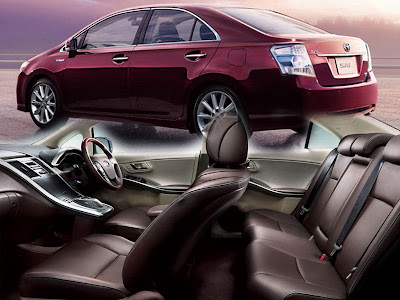
2010 Toyota SAI Hybrid Sedan a redesign of the Lexus HS250 hybrid


Toyota Motor Corp will be releasing a new petrol electric hybrid in Japan while the Prius will compete with Hyundai Motor Co in Korea. Toyota hopes to sell 36,000 of its new Sai hybrid sedan, Toyota’s goal being one million hybrid cars a year globally after 2010.
The Sai is Toyota’s second hybrid-only car, this car is a redesign of the Lexus HS250 hybrid. The Sai is based on a concept derived from the Japanese word sai-which means "talent" when written as "" and "coloration" when written as ""-as a hybrid-only sedan "combining advanced talent and multi-color sophistication".
The Sai is based on the Lexus HS250h hybrid, a vehicle designed for people who want a more premium hybrid experience than they would get in the Toyota Prius. The Sai would seem to fit somewhere in between. It offers the same powerplant as the HS, but not quite as many luxury features. It's basically an HS with different nose, tail and interior detailing.

The Toyota Sai Hybrid features a gasoline-electric hybrid system with a 2.4-liter engine for outstanding fuel efficiency and use of Ecological Plastic for approximately 60% of the interior surface area. The Sai features the Toyota Hybrid System (THS) II combining a 2.4-liter Atkinson cycle combustion engine with an electric motor and a reduction gear. The Toyota Sai Hybrid uses a 2.4-liter petrol engine generating just under 150 horsepower, and up to 187 Nm of torque. It is mated to a strong electric motor, powered by a nickel-metal hydride battery, which produces an additional 140 hp and up to 270 Nm of torque. The Toyota Sai Hybrid powertrain is designed to utilize the two generators efficiently, giving the driver up to 185 hp at any given time.
An exhaust heat recovery system uses exhaust gas to heat the engine, thus shortening engine-warming time and contributing to greatly improved fuel efficiency, especially when outside temperatures are low.

LED headlights conserve electric power and consequently reduce power-generation requirements on the engine.
In addition to Standard Driving Mode, which balances fuel efficiency and power, drivers can also select Eco-Drive Mode, which prioritizes fuel efficiency by moderating driving force relative to accelerator operation and putting the air conditioner into a low energy-consumption mode, and Electric Vehicle (EV) Drive Mode, which uses the electric motor only, resulting in extremely quite cruising and zero emissions.
A Hybrid System Indicator that shows real-time driving status and an Eco Driving Indicator that lights up to signify fuel-efficient vehicle operation provide visual support to the driver.
The ESPO1 system, which encourages and rewards environmentally considerate driving, enables drivers to gain extra enjoyment.
G-BOOK mX, TMC's advanced telematics service, assesses environmentally considerate driving and awards points to driver; mastery of eco-driving can be determined according to rate of points gained each month

Programs that allow drivers to make donations to charities using points received, that rank fuel efficiency of nationwide Sai ESPO users, and other fun incentives to encourage drivers to drive in environmentally considerate ways, are available
Toyota is also sending its brand to South Korea where the Hyundai Kia partnership dominate. The Prius and Camry hybrids will be first and joining them will be the petrol version of the Camry and the RAV4.
Toyota Executive Vice President Yukitoshi Funo told a news conference, “The introduction of the Toyota brand into South Korea is aimed to meet the diversifying needs of consumers in this growing market,”
“We intend to make every effort to contribute to South Korean society and earn a loyal following.”
December the seventh is the release date for the Toyota Sai retailing at 3.38 million yen ($40,250), the Lexus HS250 is priced at 3.96 million yen ($47,159).
The Sai is expected to have a consumption rate of 4.34 liters per 100 km. At this stage Toyota has no plans to export the Sai, preferring to concentrate on the home market.