Showing posts with label Toyota. Show all posts

Wednesday, February 16, 2011

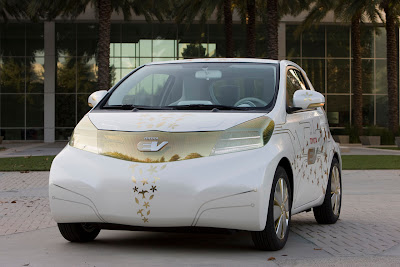
2011 Toyota iQ EV prototype

2011 toyota iq ev prototype 2011 Toyota iQ EV prototype

Toyota iQ all-electric prototype will make its European debut at the Geneva Motor Show in March. The EV prototype is currently being tested on European roads, with a potential market launch through a leasing programme in 2012. The Japanese company will also bring the car in the USA (as a Scion) and is also investigating its viability in other regions.

The iQ EV is equipped with an electric motor fed through a newly developed, flat and compact lithium-ion battery that is mounted under the car’s floor. According to Toyota, the battery pack doesn’t reduce the regular iQ’s load area or passenger space. The all-electric version of Toyota’s mini car is said to have a potential driving range of up to 65 miles or about 105 kilometers.

In addition, 2011 Toyota iQ EV prototype will join three more new models at the firm’s Geneva Salon stand including Yaris HSD hybrid concept, the European market variant of the Prius+ minivan with seven seats, and a closer to production concept of the FT-86 rear-wheel drive coupe.

Saturday, February 12, 2011

New 2011 Toyota Matrix reviews

2011 Toyota Matrix will be presented at the 2011-Chicago Auto Show this week. Styling differences between the 2010 - and 2011-version of his Matrix barely noticeable changes.

Sport five-door Toyota Matrix combines nimble fun-to-drive spirit of a small SUV with the tools and excellent fuel economy. In 2011, Toyota Matrix, a new standard wheels, interior parts, Toyota, carefree maintenance standard Smart Stop.

A subtle update is limited to the exterior of all new front and rear bumpers with integrated front and rear lower spoilers and an extensive network of fog cover. The redesigned 16-inch steel wheels and 17-inch five-spoke wheels, plus the introduction of new spruce Mica paint a complete change.

While the interior of 2011 Toyota Matrix: meters on the dashboard has a new silver lining, and the new gilded metal rings around the ventilation, air conditioning, audio equipment has a new flush surface. The updated model also gets a new selection of the fabric of the chairs and there is a newly designed leather steering wheel with integrated audio controls and talk hands-free Bluetooth.

2011 Toyota Matrix, the Star Safety System ™ display as standard equipment includes Vehicle Stability Control (VSC), Traction Control (TRAC), Anti-lock Braking System (ABS) with electronic brake force distribution (EBD) and Brake Assist. It also includes the standard Smart-Stop brake system suppression.

2011 Toyota Matrix is available in two levels: the base model is powered by a 132HP 1.8-liter engine with five-speed manual or a four-speed automatic transmission, while the version 158Hp 2.4-liter four-cylinder engine deal with five-speed manual or an automatic transmission. The model comes with All Wheel Drive (AWD), in this case 2.4-liter engine is responsible for a 4-speed automatic.

The car is very economical, basic matrix have EPA-estimated fuel 1.8L 25 points and 32 mpg city mpg highway with manual transmission and 26 mpg city and 32 mpg highway for automatic model while 2.4LS version 21 mpg city and 28 mpg highway with the shift, 21 mpg city and 29 mpg with automatic transmission and 20 mpg city and 26 mpg highway for AWD models.


Wednesday, January 26, 2011

New Toyota Teases FT-86 II Coming to Geneva

Since Toyota’s acquisition of a 17.1% stake in Subaru’s parent company Fuji Heavy Industries in 2008, the automotive press has speculated by a sports car developed between the two.

The FT-86 Concept at the Tokyo Auto Show in 2009 previewed Toyota’s version of the car. We haven’t heard much from Subaru until a recent confirmation of a concept coming to the Geneva Motor Show. Now it’s Toyota’s turn, confirming an FT-86 for the Geneva Motor Show.

Notice A FT-86 not THE FT-86, because the new car is just a concept once again. It is dubbed the FT-86 Concept II, and promises to be much closer to the final production version.

We just want to see the production car already though. Toyota, with a spate of bad news recently, is milking this one for all its worth however.

It has been criticized for making boring, passionless cars, but in its press release Toyota says the car “embodies the company’s reborn passion for sports car driving.” What do you think, is the FT-86 II likely to be the real deal or are you already sick of hearing about it?

Monday, January 24, 2011

New Camry That’ll Blow Your Doors Off!

earlier in the U.S., it seems like the Toyota Camry is to solve the driver feel better about themselves. Ok, maybe I'm simplifying things. The Camry is the most measurements, a large car. It is practical, affordable, reliable, incredibly quiet, good on gas, and has a high residual value. Unfortunately, this is about as interesting as watching paint dry. Numb steering, sewing machines, engines, internal Tupperware, squishy brakes, automatic transmission - it was designed so that you remove the disc from the company, but you can join. I know that some people (certainly not us, and hopefully not our readers!) It actually a good thing. But the car guys, we would rather drive the determination Alfa Romeo Camry.

But the Australians are smart bunch. When it comes to cars they can apparently make something out of nothing. Remember Holden (VT), HSV GTS Commodore? 402 hp, 4-door sedan powered by an enhanced LS1 6-speed that many journals than positive E39 M5? Well, it breaks the surface of a large number Opel Omega, which has led to a piece-of-junk Cadillac Catera here in the U.S.. Sow's ear, silk scholarship, etc.
When he realized that the Toyota Avalon was sold poorly in Australia, we have begun alternative that is still based on gut feelings to develop Camry. Toyota Aurion is actually designed in Australia under the new (XV40) Camry chassis, which debuted in 2006. While we choose our Camry 2.4L I4 or 3.5L V6 engine, it was decided to split between the two models - the Camry only four of the value of a benevolent leader and loves the Aurion is only six years.

As the Aurion is primarily intended to compete with larger cars such as Commodore and Falcon, it was decided that the performance variability was needed. After all, there are many different Falcons FPV and HSV Commodores are a lot of energy, robust body kits, tight suspension, etc. - and Australians to eat. So why not a hi-Aurion? TRD (Toyota Racing Development) was established to work faster, more economical Aurion.

The most obvious change with the TRD Aurion is a version of The Fast and the Furious look bodykit. It looks like a mixture of HSV, the Lexus LS460L, a knife wound. It was a little boy racer, but he made sure he was not the TRD Aurion looks boring cars. The front Valence are bottom-feeders deep, rectangular exhaust pipes are integrated into the bumper, split-spoke 19-inch wheels are wrapped with 35-series tires and somehow at him and nodded his head shaking, so your head and realize Camry Underneath It All! damn good looking car surprises of parenthood.

True Magic is under the hood, though. All Australian Aurion comes standard with Toyota's 2GR-FE 3.5L V6 injection port. It's quite healthy plants with dual VVT-i, 24 valves and four cameras, and 270 horses. On top of that, added TRD Eaton TVS (Twin faith) compressor, the same kind used in the ZR-1 and CTS-V. Interestingly TRD Aurion was the first production car to use the TVS supercharger. This rapid convector gives the engine a very broad powerband, with 300 Nm (221 lb-ft) of torque available from 1250rpm all the way to redline. TRD has a maximum torque output of 400 Nm (that's € 295-ft) at 4,000 rpm. The greatest strength? 241kW (323bhp to the rest of the world), the TRD Aurion is FWD, the world's most powerful production car, if I remember correctly.

Ower is transmitted through a 6-speed automatic transmission with manual shift matic skills, and the country through 245/35/ZR19 performance tires. Brakes are larger, 325 mm front with 2-piston aluminum calipers rear 310 mm single-piston caliper, ventilated both ends. Used cars Ferodo HP1000 pads at both ends for an even greater friction. TRD uses the same basic suspension settings as a non-turbo Sportivo (if they come up with these names?), But 12 mm lower at a higher rate springs and dampers.
on the inside does not escape unscathed. Although I'm sure you are satisfied, the red and black sports seats are just painful to watch. The rest of the interior is pretty much standard Camry / Aurion, which means that it is comfortable, well built and modern. There are two trim levels TRD Aurion: basic 3500S and 3500SL better prepared, who added more skins, more space adjustment, an intelligent key ring or other small items.

So how is the world's most powerful front-wheel drive, TRD Aurion do? Well, that's right fast: Toyota quoted 0-100 km / h (62.5 mph) time of 6.1 seconds, quarter-mile in 14.2, although owners report that when the traction control system (turn which are made through a complicated process, because no contact), they were unable to mid-fives to 100 km / h, mid-13's in the third quarter, that's damn fast. TVS blower is considerably less noise than older style compressors, so I was not nagging things humming under the hood - just tons of energy. The problem was front wheel drive - the journalist who conducted TRD Aurion reported rampant torque control et al. Sounds like a Saab Viggen!
CarAdvice road test Australian publication gave Auto 3 / 5, and was just full of beautiful words in driving dynamics. Namely: "Toyota missed the mark with the new TRD Aurion is impossible to make the car drive without fear, in which direction the car will send you an inch is just too much power being pushed through the front wheels to create a viable car.".

And to be honest, the TRD brand in Australia is not only easy to live. Toyota has launched a partnership model Aurion, TRD HiLux super (which is very similar to the U.S. market, Tacoma is) with a blown 4.0L V6 too. Problems arose early. Toyota Aurion delayed two quarters, while the eeked more power from the engine and then switched to selling uncomfortable halt when the market goes down, when exploded early production models of the engine. All problems are solved, TRD Aurion already on sale in autumn 2007 ...

... I look around TRD operation at the end of 2008. With a total of 537 Aurion TRD (TRD 351 and Hilux models) sold in the whole lifecycle of the operation was very successful. Critics call the high price, hallways, and front-wheel drive architecture. I think the world was simply not prepared for wind, good Camry. Either way, how they won the speedometer needle scale and say that we're better off without him. Certainly not believe.
Maybe Toyota will be a little more credit as a producer of cars people want to drive if you have associated with Eaton TVS Camry V6 here in the 'States? Not likely, but we can keep dreaming. Hi, I `d run a.

Friday, January 14, 2011

Toyota Yaris 2007

 Toyota Yaris Photo Galery
 Toyota Yaris Engine


 Toyota Yaris

 Toyota Yaris


 Toyota Yaris Interior

 Toyota Yaris Red

 Toyota Yaris

Wednesday, January 12, 2011

2012 Toyota Prius V

Toyota Prius V shares the same platform and hybrid drivetrain as the regular, five-door model, however, Toyota claims the minivan will feature over 50-percent more interior cargo space than the current Prius.

In interior of Toyota Prius V offers seating for five with increased headspace and visibility, as well as 34.3 cubic feet of cargo space. The 60/40 split, folding rear seats allow for four different seat arrangements, while a fold-flat front-passenger seat allows for longer cargo.

2012 Toyota Prius V will offer an available lightweight resin moon roof with retractable sunshades, boasting a 40-percent reduction in weight compared to conventional glass roofs of the same size.
The Prius V will offer an available lightweight resin moon roof with retractable sunshades, boasting a 40-percent reduction in weight compared to conventional glass roofs of the same size.
It is third-generation Prius as well as the forthcoming Prius Plug-in Hybrid Vehicle (PHV), starting from late summer 2011. And the hybrid minivan will also be the first vehicle to offer Toyota’s all new, Entune multi-media system that debuted last week at the 2011 Consumer Electronics Show in Las Vegas. The new system supports mobile apps, such as Bing, OpenTable, and movietickets.com, as well as allowing access to travel-related services, such as live weather, traffic, fuel information (location and price), stocks, news and sports.

Toyota Prius V features the same hybrid drivetrain as the regular Prius matting a 1.8-liter Atkinson-cycle gasoline engine with an electric motor. Toyota said the Prius V will deliver estimated EPA fuel economy ratings of 42 mpg city, 38 mpg highway and 40 mpg combined.


2012 Toyota Prius V

Tuesday, January 11, 2011

New Toyota Shocks Detroit With Smaller, More Efficient Prius

Toyota unveiled long-awaited addition to cars and plug-in Prius line, but it sounds like: a smaller Prius C concept, the production of Toyota says that the first position of the fuel efficiency when it goes on sale next year.

Toyota Shocks Detroit With Smaller, More Efficient Prius

Prius than C away from direct access to all the current Prius, which aims to monitor the subcompact and compact. Toyota has no information on the price or the full production version of the glasses, but said it was the young urban couples who want to maximize fuel efficiency target. Current title holder of the most efficient hybrid Prius is a regular media at 51 mpg city/48 mpg highway.
Toyota Shocks Detroit With Smaller, More Efficient Prius
2012 years Toyota launches plug-in version of the standard Prius, a short 13-mile all-electric range of sports. Prius (Prius or Grand), coming later this year, add a few cubic meters of cargo space in the back while getting 42 mpg city/38 mpg highway, any attempt to broaden the scope to exploit what could be several years rising gas prices.

Friday, November 26, 2010

2010 Toyota FT-EV Electric Cute Car

Toyota FT-EV Electric Car 1Toyota Motor Sales (TMS), U.S.A., Inc. today announced that it will display the Toyota FT-EV concept on opening Media Day at the North American International Auto Show (NAIAS), confirming its plan to launch an urban commuter battery-electric vehicle (BEV) by 2012. This announcement, coupled with its compressed natural gas powered Camry Hybrid concept display at the 2008 Los Angeles Auto Show, signal Toyota’s intention to broaden the scope of its advanced alternative-fuel vehicle development.
Toyota FT-EV Electric Car 2“Now, more than ever, while we are so focused on the pressing issues of the moment, we cannot lose sight of our future,” said Irv Miller, TMS Group Vice President, Environmental and Public Affairs. “Nowhere is this more important than with our industry’s duty and commitment to provide true sustainable mobility with vehicles that significantly reduce fuel consumption, our carbon footprint and overall greenhouse gases.” The FT-EV concept shares its platform with the revolutionary-new iQ urban commuter vehicle. Already a huge hit in Japan, the iQ is lightweight and seats four passengers in comfort and security, while delivering exceptional mileage, sporty performance, unique refinements and a fun, youthful image.

Toyota FT-EV Electric Car 3Toyota’s FT-EV concept imagines an urban dweller, driving up to 50 miles between home, work and other forms of public transportation, such as high-speed rail. Although, for now, the FT-EV remains a pure concept, it represents a natural pairing of product strategies.

Toyota FT-EV Electric Car 4“Last summer’s four-dollar-a-gallon gasoline was no anomaly. It was a brief glimpse of our future,” said Miller. “We must address the inevitability of peak oil by developing vehicles powered by alternatives to liquid-oil fuel, as well as new concepts, like the iQ, that are lighter in weight and smaller in size. This kind of vehicle, electrified or not, is where our industry must focus its creativity.” Although BEVs and new smaller vehicles like the iQ will be a key component of Toyota’s sustainable mobility strategy, the conventional gas-electric hybrid, like the all new third-generation Prius, is considered Toyota’s long-term core powertrain technology.

Toyota FT-EV Electric Car 5Last year, Toyota announced that it planned to sell one million gas-electric hybrids per year sometime during the early 2010s. To accomplish this, Toyota will launch as many as 10 new hybrid models by the early 2010s, in various global markets. The new third-generation Toyota Prius and all new Lexus HS250h, both debuting in Detroit, are the first two examples of that effort. Also, last year, Toyota announced that it would roll-out a large number of plug-in hybrid vehicles (PHVs) to global lease-fleet customers in 2010. That schedule has been moved up.

Toyota FT-EV Electric Car 6Beginning in late 2009, Toyota will start global delivery of 500 Prius PHVs powered by lithium-ion batteries. Of these initial vehicles, 150 will be placed with U.S. lease-fleet customers. The first-generation lithium-ion batteries powering these PHVs will be built on an assembly line at Toyota’s PEVE (Panasonic EV Energy Company, LTD) battery plant, a joint-venture production facility in which Toyota owns 60 percent equity. During its development, the new Prius was designed and engineered to package either the lithium-ion battery pack with plug-in capability, or the nickel-metal hydride battery for the conventional gas-electric system. The 500 PHVs arriving globally in late 2009 will be used for market and engineering analysis. Lease–fleet customers will monitor the performance and durability of the first-generation lithium-ion battery, while offering real world feedback on how future customers might respond to the plug-in process. “Future customers will have high expectations for these emerging technologies. This Prius PHV fleet program is a key first step in confirming how and when we might bring large numbers of plug-in hybrids to global markets,” said Miller. “Our business is no longer about simply building and selling cars and trucks. It is about finding solutions to mobility challenges today and being prepared for more daunting challenges in our very near future.”