Showing posts with label Mazda. Show all posts

Tuesday, February 15, 2011

Cheapskate Survivor: 1985 Mazda RX-7

This 1985 Maxda RX-7 wears all original paint, has a perfect original interior, and is photographed way too well for a car at this price point. Yeah, it is only a basic GS model, but it is noteworthy on condition and documetation alone. It looks like an excellent turn-key driver for peanuts. Find it here on Craigslist in Danville, California for $5k. Special thanks to BaT reader Kurt H. for this submission!

1985 Maxda RX7 GS California Survivor Original Paint For Sale Front

White looks good on these cars, and even the factory pin-striping has held up well. These wheels are one of the iconic designs for the model, and work well even though they were old news by 1985. The car wears its original blue california plate on the rear and is clean with none up front. The seller claims one owner, but doesn’t make any of the usual references towards himself owning the car in the early days. A call would sort out who originally bought the car in ‘85.

1985 Maxda RX7 GS California Survivor Original Paint For Sale Rear Lake

The interior is the amazing part. The factory bucket seats are in ridiculously good shape for 116k miles. The shift boot and steering wheel are equally excellent.

1985 Maxda RX7 GS California Survivor Original Paint For Sale Interior

The engine bay looks used but reasonably clean and the rotary powerplant looks all stock down the the lettering on the air cleaner. This one also has A/C which would be very desirable in the summer months where it is being offered.

1985 Maxda RX7 GS California Survivor Original Paint For Sale Engine

Everyone ought to own a rotary before they die, and this RX-7 offers about the easiest entry point we have found. It is hard to imagine how anyone would lose badly on this car. Buy it, play with it for a year, and then drive it to the rustbelt to sell it to someone who hasn’t seen one on the road in 15 years.

Monday, February 14, 2011

New Mazda MX-5 Roadster Review; 900,000 Vehicles

Mazda MX-5 Roadster Review; 900,000 Vehicles Sold Later

The favourite car of 800,000 or so hairdressers since it first appeared in 1989, the 900,000th Mazda MX-5 Miata rolled off the Mazda assembly line over in Japan recently. I suppose the remaining 100,000 were bought by motoring enthusiasts. But jokes aside, this little open top sports car managed to capture the spirit of classic British open top motoring. It heralded a second coming for affordable open top motoring and is actually what a small roadster should be – light, agile and mechanically uncomplicated.

It has been debated that the Miata is more British than the current crop of British sports cars. Imagine that, the quintessential British sports car is Japanese. Anyway, what better way to celebrate this milestone by featuring one right here on CarThrottle. A third generation NC series JDM spec Mazda MX-5 ‘Roadster’ from 2005. But, before I start telling you readers out there how this car actually drives lets go back down memory lane for a brief overview of the MX-5.

It all started in the 1980s when no one was actually building proper roadsters. None of the major manufacturers in Europe were producing small open top sports cars like they used to do eight or nines years earlier. In the late 1970s up to 1980 British Leyland via MG produced the MGB Roadster. The only other convertible that carried on after that was the horrid looking ‘ultra wedge’ Triumph TR7 convertible and this was considered to be something totally weird and not really that cool to have. Only Alfa Romeo soldiered on with the Alfa Spider through the 1980s and early 1990s which by then was totally ancient. You can’t blame Alfa Romeo for continuing the Spider way past its sell date as it was a good looking roadster. But it was Italian. This meant that its electrics had a mind of its own and it would sometime decide to go on strike more often than some labor unions would.

Anyway, somehow someone in Mazda must have felt extremely nostalgic about those small, tiny British roadsters especially the Austin Healey Sprite and the Lotus Elan. This person convinced the management of Mazda to come out with a small affordable front engined, rear drive roadster in the mold of those British Roadsters from the 1960s. After nearly a decade of research and development, the MX-5 was launched in 1989. It had a 1.6-litre engine and only weighed 940kg back then. This enabled the MX-5 to hit sub 8 second 0-100km/h (0-62mph) times and a top speed of 210km/h or 130mph. Pretty decent times even for today.

This first generation MX-5 was called the ‘NA’ series. A good 400,000 units of it were sold from 1989 to 1997 and in 1998 the second generation, slightly heavier 1.8-litre (also with a cut price 1.6-litre version) NB model was launched. This model soldiered on to 2005 where the third generation NC model was launched with a 2.0-litre engine and it was also much heavier than the previous models (1,100kg on average). This happened due to increased safety equipment (which included traction control, that could be switched off, for the first time) but on average, the MX-5 was still much lighter than most contemporary sports cars. Well, bar the Lotus Elise, which isn’t a traditional roadster in the first place.

The 2005 MX-5 Roadster I tried was a low mileage gray import from Japan and was only recently registered over here in Malaysia. It had 10,000km on the clock when I tried it and it felt like it. Everything was taut and precise. There were no rattles or squeaks throughout the drive and the interior was surprisingly very well built. The tan leather complimented the dark colored plastic fittings and Onyx wood trim on the dashboard. Oooo…Onyx. Something people in the Cotswolds would love. The quality of materials used was also surprising. It felt very tactile to the touch and the quality was high. If you stepped out from a 2006 BMW Z4 and into this you wouldn’t be disappointed (If you stepped in from an Audi TT then it would be a different question – it basically shows that the BMW’s interior isn’t all that great in the first place).

The 2.0-litre engine produces 170bhp and around 190Nm (140lb/ft) of torque. It is a responsive powerplant but sounds and feels agricultural. Somehow Mazda 4-cylinder engines are like this. I remember driving quite a fair number of Mazda 323 Familias from the late 1980s and the 1990s which basically felt coarse sounding. However this being a 2005 car it was slightly surprising. But in this Mazda the engine does its job well. This car was coupled with the optional 6 speed automatic transmission and it was very sprightly. The automatic holds up to the redline and shifts quickly. And if you use the steering mounted pedal shifters you still have some semblance of control, especially when you’re downshifting before a corner. I feel that Mazda’s 0-60mph estimate of 7.9 seconds is an understatement. This car is clearly a low 7 second car to 60mph after gunning it a couple of times.

The car somehow really does feel like a British roadster. I for one should know as last November I happened to clock over 200 kilometers in a 1954 MG TF 1500 Roadster. It somehow shares the distinct DNA of the old girl in feel. The light, agile feeling from the old British roadster is carried over into the MX-5. Even the driving position is low and ergonomically suited to my physique. Direction changes in the MX-5 are sweet. It is a very nimble car and with good steering feel. Some may have complained that the current crop of MX-5s do not have as much steering feel as the older cars but if you compare the MX-5 with other contemporary sports coupes, hot hatches or rally specials that populate the performance car market you will find that the MX-5′s steering is still pure and direct. I remember driving a Nissan 350Z a while back and I felt that I did like how the steering felt and I also remember driving Lancer Evolutions that had really good steering feel for an all-wheel drive but the MX-5 still felt purer in feel. This isn’t something about steering accuracy, but just purely on feel. Something that isn’t really quantifiable.

So the engine is sweet, the steering is nice and these two items make driving the car better. The car feels so small and light compared to other, mostly heavier, performance cars out there in the market these days. After getting used to the car’s very nimble ways it is easy to steer into a sharp bend at higher than usual speeds. You have a responsive and planted front end and a very agile rear in the MX-5. And the fact that you’re sitting almost on top of the rear axle makes you actually know how its going to react. If you punt it into a corner it just turns in and the rear assists with a gentle nudge in the right direction. No I didn’t push it into an oversteer or anything like that this time around as traffic didn’t permit it. I merely drove it as the traffic permitted but took the corners with added gusto to get a better feel of the car (I was as fast round the bends as on the straights). The ride is also pretty good and it wasn’t harsh or choppy. Although sometimes the tail may step out where there are dips and crests, much like how roadsters did in the good old days.

I actually liked this current MX-5. The car looks very up-to-date and current especially with the factory fitted bodykit option. More Mazda RX-8 in terms of looks too. With the 2.0-litre engine it does feel easily at ease at speeds above the ton compared to the older models. Although some may have complained that it isn’t as pure as the earlier versions I beg to differ. More RX-8 sports car-like instead of British roadster-like they may say. Yes it does have added refinement and I think that is a good thing. It may supposedly lack steering feel and response of the older models but compared to what you get to drive these days it is still magical. You still sit lower than the RX-8 and you still sit close to the rear axle that this MX-5 does not feel like you’re driving a RX-8 or any other large Japanese sports car (like the Nissan 350Z or the sort). It is therefore a traditional British roadster in every sense except that it is made thousands of miles from where the concept originated from.

So there you have it. A short write up on a car that over a period of 12 years sold close to a million cars and one which I hope will continue to uphold the virtues of affordable and fun open top motoring for generations to come.

Saturday, February 12, 2011

New 2011 Mazda MX-5 Special Edition

Mazda MX-5 Special Edition will be available in the U.S. in a limited series of 750 seats, but at a much lower price as the U.S. version starts at $ 30,925 with a manual transmission and $ 31,525 when equipped with six-speed sport automatic . This is compared with U.S. $ 47,800 for the Australian market model.
Validity of the Limited Edition comes standard with a 2.0-liter four with 167 hp atmospheric and 140 Nm of torque and will be available shortly after its debut this week at the Chicago Auto Show.


2011 Mazda MX-5 is available in two new colors, Sparkling Black Mica or Dolphin Grey Mica. Special Edition is based off a fully-equipped Grand Touring model with a roof and rides on 17-inch alloy wheels Bright Finish.


Interior Mazda MX-5 Special Edition for the state of the market gets a gray door trim and heated leather seats with gray stitching, black leather-wrapped handbrake and steering wheel with contrasting red stitching, chrome finish air vents and instrument panel, plus alloy pedals when they are equipped manual gearbox.

The main addition is the suspension package, which is optional on Touring and Grand Touring model, and includes Bilstein shocks, limited slip differential (LSD) and sport-tuned suspension.

Thursday, January 13, 2011

New Mazda 5 2.0 TS2

What is it?

This is the first time we’ve driven the Mazda 5 in the UK, and the first time we’ve sampled the finished example of the new 2.0-litre petrol motor, driven through a six-speed manual gearbox and with the start-stop tech from the 3. Mazda wanted to make the 5 entertaining to drive, and within the parameters that the laws of physics set for big, tall cars, it is.

Mazda 5 2.0 i-stop TS2 (UK):This is the first time we've sampled the finished version of the 2.0-litre engine

What’s it like?

There’s plenty of grip, progressive and accurate steering and a balanced chassis that responds well to spirited driving.

The risk with focusing on making an MPV entertaining is the compromise it can bring in terms of comfort, but Mazda has struck a good balance between body control and ride quality. On UK roads there is some slight fidgeting over broken surfaces, but the big-bump absorption is pliant and effective, particularly at low speeds, and in general it does a fair job of isolating occupants from the road surface.

Mazda 5 2.0 i-stop TS2 (UK):This is the first time we've sampled the finished version of the 2.0-litre engine

Cabin refinement is a strong point with this 5, which is a necessary bonus, given that a 2.0-litre petrol engine such as this has few merits these days beyond its relative lack of noise. As well as being very hushed, the Mazda benefits from a quick-reacting stop-start system, a slick gearshift and a light clutch that make it a compelling urban tool.

Mazda 5 2.0 i-stop TS2 (UK):This is the first time we've sampled the finished version of the 2.0-litre engine

Should I buy one?

For all its attributes, the 5 is still a niche choice. It falls short on the passenger space, cabin flexibility and residual strength offered by its rivals, such as the Peugeot 5008. The diesel unit due next year could solve some of these problems, but until then the Mazda 5 is a car that is likeable, if a little hard to justify.

Mazda 5 2.0 i-stop TS2 (UK):This is the first time we've sampled the finished version of the 2.0-litre engine

Vicky Parrott

Mazda 5 2.0 TS2

Price: £18,895; Top speed: 120mph; 0-60mph: 11sec; Economy: 40.9mpg (combined); CO2: 159g/km; Kerb weight: 1485kg; Engine: 4 cyls, 1998cc, petrol; Power: 48bhp at 6200rpm; Torque: 144lb ft at 4500rpm; Gearbox: 6-spd manual

Wednesday, October 20, 2010

Mazda CX-7 Review


As impressed as I am with the Mazda CX-9, the smaller Mazda CX-7 may be the better vehicle for the largest number of people.


Shorter and seating five rather than seven, the CX-7 is a strong alternative to small SUVs and more expensive crossovers.


Mazda's attention to detail and focus on fun are what seal the deal. Not to mention economic factors. Opt for a CX-7 and $22,340 buys you a 16-valve four with a five-speed automatic transmission, independent front suspension, dynamic stability control, traction control, four-wheel anti-lock disc brakes, 17-inch alloy wheels, power locks, windows and mirrors, air conditioning, Bluetooth, a multi-function information display, a leather-wrapped steering wheel, remote keyless entry, and a better-than-average four-speaker AM/FM/CD/mp3 audio system.


I'll repeat. That's standard. For the base price of $22,340. Stop there, pay the $750 delivery fee and you've just barely crossed into $23,000.


Mazda sweetened the press tester with a cargo net, fog lights, a retractable cargo cover, Sirius Satellite Radio, scuff plates and a convenience package that included heated front seats, a moonroof, a rear-view camera, power driver's seat and an upgrade for the air conditioning to automatic climate control.


And the bottom line was still only $25,990.


This, my friends, is a deal.


But wait! There's more!


As in five-star frontal and side crash ratings, four for rollover....and an EPA estimated 20 city, 28 highway miles per gallon.


And because of that fun factor I mentioned earlier, it's like driving a sports sedan. The CX-7 breezes onto the TireKicker Top 20 Cars list. It's that good.


UPDATE: Just did a week in an uplevel turbo version of the CX-7 (courtesy Camelback Mazda in Phoenix)...yeah, you're boosting the bottom line to $30K or better...but you're also boosting the horsepower to 244...which makes a major difference in the fun factor. And you're only giving up 2 mpg city and 3 highway (18/25).

Sunday, September 26, 2010

Mazda CX-9 Review


As the tide turns from traditional truck-based SUVs, a lot of people are discovering the larger crossovers (sport-utes based on car, rather than truck, platforms). It's turning into a crowded field (including four from General Motors alone)...but there are standouts, and one is the Mazda CX-9.


As noted in previous entries here at TireKicker, Mazda doesn't make bad cars. And the CX-9, based on the very good previous-generation Mazda 6, is a strong contender.


The CX-9 is big enough for three rows of seats accomodating seven passengers. The weight of the vehicle, people and stuff is pulled (yep, front-wheel drive) along by a 273 horsepower 3.7 liter V6 with a six-speed automatic transmission. The six speed helps nudge the EPA estimated mileage into respectable territory...16 city, 22 highway.


Ordered in Grand Touring trim, as the test vehicle I drove was, the CX-9 shows up with 20-inch aluminum alloy wheels, automatic Xenon headlights, leather-trimmed seats (including an 8-way power heated driver's seat), Bluetooth hands-free capability for your cell phone, a three-zone climate control and a six-speaker AM/FM/CD audio system. Price: $33,355.


Options on the tester included Sirius Satellite Radio, a blind spot monitoring system, a package including a moonroof and a 277-watt, 10-speaker Bose surround sound sytem with a six-disc changer in the dash, a towing package and a GT Assist package...including navigation, rear view camera and power rear hatch. That propels the bottom line (with delivery charges) to $39,405. ..which puts it right in the hunt with a similarly loaded GMC Acadia.


Safety's a plus here, too, with the CX-9 getting a five-star rating from the government for frontal and side crashes for the driver and passenger, and a four-star rollover rating.
As a smaller manufacturer, Mazda often gets overlooked. In this case, that would be a big mistake.


UPDATE: Just finishing a week and a few days in the base-level CX-9 Sport (courtesy Camelback Mazda in Phoenix)....one without any options whatsoever. And it's brilliant. How? Because the basic goodness of the CX-9 as above is there...but the lower standard equipment level (not lower by much) and lack of options keeps the price just a nick under $30,000 as tested. That's ten grand below the sticker price above....for the same basic vehicle. Go. Drive. One. Now.

Sunday, September 12, 2010

Mazda3 Hatchback Cars 2010

Mazda has officially taken the wraps off its five-door hatchback version of the redesigned Mazda3 at the Bologna Motor Show today. As you can see in the gallery of new high-res pics below, the Mazda3 five-door gets the same swoopy sheetmetal as its four-door brethren, including the super happy smiley front end face. What's new is an extended roofline that drops down at a steep angle to create a wagon-esque profile. With a D-pillar that kinks up at a swept back angle, the look is very similar to that of a Pontiac Vibe/Toyota Matrix that's been stepped on by a giant. The new cargo capacity will no doubt be appreciated by families who can put every extra cubic foot to good use, and if the current generation Mazda3 is any indication, this will also be the basis for the Mazdaspeed model.


At the moment, all the specs for the new Mazda3 five-door hatchback are for the European market, so don't expect its new 2.2L and carryover 1.6L turbo diesel engines to be available in the U.S. Europeans will also have a choice of 1.6L and 2.0L gas engines, though we expect the U.S.-spec model to offer the same 2.0L and new 2.5L four-cylinder engines as the sedan. Check out the official press release from Mazda after the jump for more details and the high-res image gallery below for more shots of the new Mazda3 five-door hatchback

Sunday, September 5, 2010

Mazda Shinari Concept

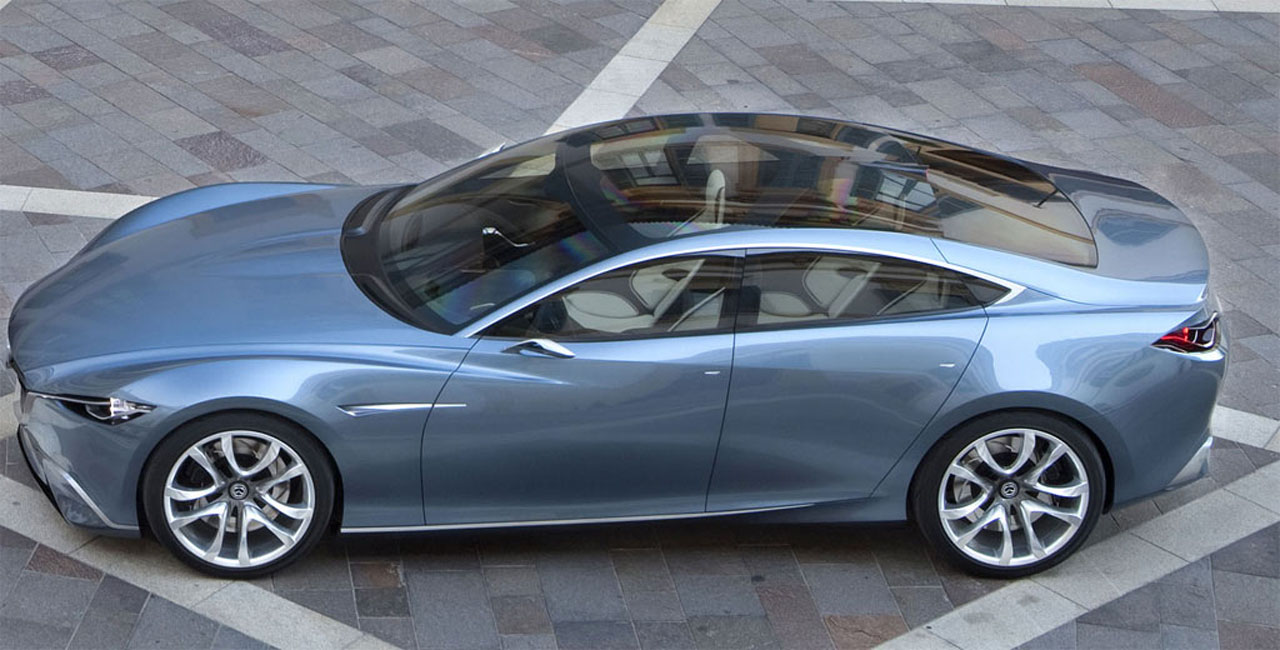
Mazda Shinari Concept
The Mazda Japanese carmaker has revealed detail of the Mazda Shinari concept . Mazda Shinari is a four-door, four-seater and sports coupe, As previously announced, the Mazda Shinari concept shows the company's new design language, called KODO – Soul of Motion. The Mazda Shinari is the first concept to use this new design language, which will be seen in the company's future production models, as well as other concepts.

The fenders of the Mazda Shinari concept are inspired by the RX8. Another distinctive feature of a three-dimensional Sinar Mazda sculpted grille. Another style of Sinar concept Mazda is likely to be made in production models is the grid floating aluminum bar between the headlights.

The interior of the Mazda Sinar was also specially designed so that it gives the driver the option of switching between three operating modes - business, pleasure and sport.

Mazda Shinari Concept Photos:

Mazda Shinari Concept 1Mazda Shinari Concept 3Mazda Shinari Concept 4Mazda Shinari Concept 5Mazda Shinari Concept 6Mazda Shinari Concept 6Mazda Shinari Concept 8Mazda Shinari Concept 9Mazda Shinari Concept 10Mazda Shinari Concept 11Mazda Shinari Concept 12Mazda Shinari Concept 13Mazda Shinari Concept 14Mazda Shinari Concept 15Mazda Shinari Concept 16Mazda Shinari Concept 17Mazda Shinari Concept 18Mazda Shinari Concept 19Mazda Shinari Concept 20Mazda Shinari Concept 21Mazda Shinari Concept 22Mazda Shinari Concept 23Mazda Shinari Concept 24


Mazda Press Release:

Mazda Motor Corporation today announced Mazda’s new design theme, ‘KODO – Soul of Motion’, and revealed the Mazda Shinari concept car, the first vehicle to embody this new theme. Since launching its first passenger car, the Mazda R360 Coupe, exactly 50 years ago, Mazda has spent many years exploring the concept of ‘motion,’ offering customers designs that were exciting both to view and to drive.

Since the launch of the ‘Zoom-Zoom’ brand message in 2000, Mazda has pursued the concept of more athletic and sporty motion, and has adopted dynamic designs for all Mazda models starting with the Mazda6 and followed by the RX-8 sports coupe and the lightweight Mazda2. In recent years, this motion-based design philosophy has been further extended to incorporate the theme of ‘motion inspired by nature’, featured in the Mazda Nagare concept car series and the new Mazda5 now reaching UK dealer showrooms.

As a result of these initiatives, since the launch of the first Mazda6 in 2002, Mazda design has been widely acclaimed, receiving 30 major accolades together with a variety of prestigious automotive awards.

Ikuo Maeda, the head of Mazda’s Design Division, explains the new KODO design theme in this way: “In our work to further evolve the expression of motion, Mazda Design has focused on the strength, beauty and tension found in the ‘instantaneous movement’ of animals at the very moment that the motion begins. This motion is so full of vitality that it stirs the emotions of those who see it. We have named it ‘KODO – Soul of Motion’, and our aim is to express movement with forceful vitality and speed, embodying this design theme in Mazda’s upcoming models.”

Maeda continues, “Mazda’s four design studios located in Japan (Hiroshima and Yokohama), Europe (Frankfurt, Germany), and North America (Irvine, California) are currently combining to take up the challenge we have set them to achieve a breakthrough in the expression of motion in car design, and to incorporate this expression into our future products.”

Mazda SHINARI

Mazda Shinari is a four-door, four-seater, sports coupe and a pure expression of the new design theme in its idealised form. Mazda Shinari showcases several new design elements that will carry forward into production, and represents the first initiative by Mazda Design to express ‘KODO – Soul of Motion’.

The Japanese word shinari describes the powerful yet supple appearance of great resilient force when objects of high tensile strength, such as steel or bamboo, are twisted or bent. It also refers to the appearance of a person or animal as it flexes its muscles in preparation for a fast movement, and it is these images that form the basis for the name of this concept car.

With a feeling of strength flowing across every panel and part, the Mazda Shinari looks ready to leap forwards at any second. Its form incorporates the expression of a strong backbone running through the body, the sudden release of pent-up energy, and the interplay of beautiful, supple movements. The distinctive front fenders represent the further evolution of the prominent fenders introduced on the RX-8. They highlight the dynamic movement expressed in the sides of Shinari , in a style that is both sporty and elegant.

Together with the further three-dimensional sculpting of the front grille, the Shinari design proudly emphasises the Mazda lineage. There is a powerful line of movement originating at the grille and continuing through the bonnet, fender, front lamp modules and bumper. Finally, an aluminium floating bar linking the grille with the headlights enhances the three-dimensional expression of speed.

In the interior, Mazda Design has created the ‘ultimate athletic space’ focused on linking ergonomics with basic mechanical functions. It has designed the optimum space for the driver’s cockpit, to enable the driver to focus on the task of driving, as well as the passenger environment, creating a sense of openness. In this model, Mazda offers new ideas for the human-machine interface in cockpit design, enabling the driver to switch at will between three modes: Business, Pleasure and Sport, to obtain the maximum enjoyment from driving – whatever the purpose of the journey.

Concept Car ‘Mazda SHINARI’
Mazda SHINARI – Fast and strong motion that strikes the heart

The Mazda SHINARI is a pure design concept model of a four-door, four-seater sports coupe which perfectly expresses the ‘KODO – Soul of Motion’ design theme in a graceful and carefree form.

The Japanese word shinari describes the powerful yet supple appearance of great resilient force when objects of high tensile strength, such as steel or bamboo, are twisted or bent. It also refers to the appearance of a person or animal as it flexibly transforms its body to generate a fast movement. Within this movement, Mazda designers discovered the potential to realize ‘KODO – Soul of Motion’.

One glance at SHINARI stirs the emotions. Its form expresses the powerful movement of a lean body with highly developed muscles, supple but at the same time filled with tension. Mazda’s desire is to reach car lovers’ hearts and go beyond the notion of rational logic. This form purely embodies that desire.

Designer’s challenge

Yasushi Nakamuta, the chief designer who led the design of the third generation Mazda MX-5, was the first to begin the ideation of the SHINARI concept: “The challenge for us was to create an innovative new expression for energetic and powerful movement; something that we had never attempted before. We began by developing the design around the image of a predator, as it strikes at its prey, or the stabbing movement in kendo, Japanese fencing, to express the instant where accumulated force is released.

Translating this initial moment of ‘instantaneous movement’ being pursued by Mazda design into the SHINARI concept car presented various challenges to both the designers and the modelers working on the project. The process involved a series of activities that saw the team draw inspiration from a variety of places. This included each team member creating sketches and freely sculpting models from clay to represent their own perceptions of ‘KODO – Soul of Motion’. It then continued with the exploration of the functional beauty seen in traditional Japanese crafts and the motion witnessed in Japan’s ancient martial arts.

As the team continued this exploratory process, Nakamuta focused on a force so powerful that it can bend a strong section of steel plate. The Mazda SHINARI design adds subtle twists and tension to create forms that express agile and powerful movement, resulting in the expression of ‘KODO – Soul of Motion’.

Exterior – unbridled expression of agile movement

With an image of strength emanating across every panel and component, the Mazda SHINARI looks ready to leap at any second. The strong backbone running through the body, the sudden release of pent-up energy, and the interplay of beautiful, supple movements – this form is the expression of all of these elements.

The appearance of the A-pillar, which tapers towards the rear of the body, the shape of the cabin, the front fender; these and SHINARI's other elements combine to create proportions that suggest the instantaneous release of energy to propel the car forward.

The distinctive front fenders represent the further evolution of the prominent fenders introduced in the RX-8. They emphasize the front wheels and accentuate the dynamic movement expressed in the side of the body, in a style that is both sporty and elegant. Character lines flow rearward from the front fenders and meet those traveling forward from the rear fenders in a multi-layered effect. This fusion creates an appearance that suggests a forceful sense of tension with a graceful beauty.

All of SHINARI's body surfaces appear as if constantly undergoing transformation. There is no static shape to be found, as if the car is in perpetual motion. For instance the subtle control of the angle of the upper surface of the side sill, from the front to the rear, results in a form that suggests a flash of speed along the body of the car.

The three-dimensional sculpting of the front grille proudly emphasizes the Mazda lineage. A powerful line of movement originates at the grille and continues through the bonnet, fender, front lamp modules and bumper. In particular the floating bar – which links the grille with the headlights – is a three-dimensional expression of speed, an accent that represents a new signature element for Mazda. For the headlights, Mazda's designers have created a headlamp structure with no outer lens, exposing the deep-set lights and suggesting the eyes of a wild animal about to pounce on its prey.

Aerodynamic performance was a major priority for SHINARI, and the centre of the lower sections – on both the front and rear bumpers – are designed to optimize the flow of air along the underbody of the car. The flared line that connects the front bumper with the side sills and rear bumper, fulfils a similar role and streamlines the flow of air along the body, while further contributing to the aerodynamic performance of the car. The outer mirror, wheels and tailpipes accentuate the sense of agility and lightness and convey a hand-made feel with a human touch which contributes to the impression of superior, premium quality.

For the body colour a luminous metallic blue has been chosen to convey an image of hard metal. The strong yet elaborate brilliance of the highlights combines with the clearly defined contrast of the shadows to create a balance between the sharp, three-dimensional form and the appearance of surfaces bending and transforming; a balance which was a design objective. The fierce, bright flash of the forged steel of a Japanese sword is combined with wisdom and sensuality to express superlative quality.

Interior – Exploring a new approach of oneness between car and driver

When creating the SHINARI concept interior Mazda's objective was to design a distinctive premium cockpit that incorporates its interior DNA. While the exterior design can be appreciated through motion, the interior, meanwhile, is experienced in a static, seated position. A commitment to essential mechanical function and excellent ergonomics has created a driver focused interior that embodies the ‘ultimate athletic space’ while expressing a sense of speed inside the vehicle.

Entering the vehicle your eye is immediately drawn to the driver focused cockpit which surrounds the driver. Its angle and surface movement sets the tone for the whole of the interior. The highlight of interior is a surfacing between the upper and the lower instrument panel which is contrasted by crisp surface edges and precision mechanical details. Interior craftsmanship is characterized by the use of bright trim work integrated along the cockpit’s perimeter and accentuating the sensation of speed. An authentic application of materials including machined aluminum, soft natural leathers and the precision design of instrumentation and controls, gives the interior an alluring quality that exceeds expectations.

Craftsmanship meets total car control

Mazda design wanted to re-define the proximity of the driver to the instrumentation and controls by establishing intuitive ‘reach zones’; what Mazda calls ‘dedicated driving ergonomics’. All instrumentation and controls have been designed and positioned to enhance the driving experience. By separating the instrument panel into two individual zones, the driver cockpit is isolated from the rest of the interior and allows the driver to focus on the task of driving. To reinforce the message of driver orientation, the design of the primary and secondary instruments echo the main cockpit shape, to provide a clean uncluttered view from the driver’s seat. Seated behind a thick-rimmed, three-spoke steering wheel the driver sits within a uniquely contoured seat, providing maximum comfort and support.

The principle of ‘dedicated driving ergonomics’ is further reflected in the car’s next generation Human Machine Interface (HMI). The availability of smaller electronic components has allowed SHINARI’s designers to create a floating HMI three-dimensional display; a design element that represents the very latest HMI technology . The system offers three distinct modes: ‘Business, Pleasure and Sport’.

The Business-mode enables the driver to stay connected to his work day tasks. In Pleasure-mode, focus is on comfort and entertainment, allowing the driver to tailor the interior mood creating a relaxed atmosphere. In Sport-mode the driving set-up is changed; the paddle shifter is activated, suspension settings are tuned for performance driving, and controls are simplified allowing the driver to focus solely on the driving experience.

The main dashboard surfaces are positioned low, and away from the occupants, creating a unique sensation of openness. The HMI interface and the dedicated seating controls for the front seat passenger represent a new level of detail and functionality for a Mazda premium interior. Even though the interior volumes have been rearranged in this way there is a high level of sportiness to enhance the feeling of driving dynamics.

SHINARI represents the profound connection of driver and machine and the beginning of Mazda's latest design theme ‘KODO-Soul in Motion’. SHINARI exhibits a functional aesthetic that will continue to evolve as Mazda continues to define its next generation of vehicles.

The quest for a Mazda original and a Japanese original

With SHINARI as the first step, Ikuo Maeda, general manager of Mazda’s design division, aims to create original Mazda designs that will be recognized around the world. He summarizes his resolve in the following words:

“My goal is to create designs that people can point to proudly and say, ‘This is a Mazda design’. There is no need for Mazda to build cars for people who are only concerned with ‘style’ and ‘trends’. Whether working on sports cars or compact cars, I have always worked to create designs that evoke an emotional response in people and I hope to keep doing the same as I remain fully committed to develop designs for people who love and admire cars. It is my personal belief that the only way to create designs that fundamentally connect with people and to create designs they love, is if the people creating them are absolutely passionate about cars and are willing to make that passion a firm policy for design expression.

“Further, I consider it vitally important to have an awareness of Japanese originality in designing cars for Mazda. This is not merely about incorporating traditional Japanese elements into car design. I believe in reflecting the Japanese spirit in car designs as part of a subconscious practice. So, while I consider where this may lead in the future, my plan is to create cars that will be instantly recognizable as a Mazda, even when viewed at a distance. My ultimate goal is to create a brand presence that car lovers around the world recognize as representing both Mazda originality and Japanese originality. Future Mazda’s will move people physically and emotionally – this is ‘KODO – Soul of Motion’”