Showing posts with label Cadillac. Show all posts

Thursday, January 27, 2011

New Cadillac To Reenter SCCA World Challenge

Cadillac and competitive races are perhaps no two words that normally are linked. However, Mark attended the Sports Car Club of America World Challenge in the past.

And so it is very successful, actually won the manufacturers championship in 2005 and 2007, along with the championship in 2005. Brando's current CTS-V series lineup is critically acclaimed for her performance chops.
Although the V series is removed to leave the STS, CTS is alive and well with a full band that includes the CTS-V sedan, coupe and sedan versions. CTS-V, billed as the fastest production sedan. With regard to the execution of the Cadillac?
With a team of capable performance cars, announced Cadillac return of the SCCA World Challenge with a two-car team that will "affirm and promote the V-Series performance. Cadillac wants to represent the car and test new technologies and gain valuable insight for future production vehicles.

The car selection is (what else?) CTS-V Coupe. The first two cars will compete in the 25th March 2011 in St. Petersburg, Florida with Johnny O'Connell and Andy immigrants cockpit.

Before the race, the car debuted at the North American International Auto Show in January. The development of racing cars are made Pratt & Miller racing engineering company. Race models will be adjusted to SCCA standards based on standard production CTS-V Coupe.

We look forward to check the new Cadillac racing. Until next month, Cadillac released plaster to deal with us. We are in love

Sunday, January 23, 2011

New Cadillac CTS-V SCCA Racecar Hits the Track

If you’ve been following the news about Cadillac’s reentry into the Sports Car Club of America (SCCA) World Championship, you’ll know that the CTS-V race car is slated to participate in its first race in March.

Cadillac competed previously with the CTS-V Sedan, winning the Manufacturer’s Championship in 2005 and 2007 (the last year of entry), as well as the Driver’s Championship in 2005.

This year’s series begins St. Petersburg, Florida from March 25 to 27. Cadillac’s race car, a CTS-V coupe, was first shown off at the North American International Auto Show earlier this month.

There is a lot that of testing that goes into commissioning a racing program. That testing has begun, with CTS-V race car hitting the track for the first time at Sebring International Raceway in Sebring, Florida. The car was driven by Johnny o-Connell and Andy Pilgrim.

Cadillac’s entry into the SCCA will be a two-vehicle team. The race cars have been produced by an an outside racing development firm, Prat & Miller.

The cars are based off a production CTS-V Coupe and then are modified to SCCA standards. We’re looking forward to see how Cadillac scores with its reentry into the SCCA series.

Friday, January 21, 2011

New Cadillac Debuts New Commercials

Although the composition of the Cadillac V-Series is smaller than ever, it is better than ever. CTS lineup is undoubtedly the star of the Cadillac product, and V-series to the center of attention lovers.
The distributed model will be offered in sedan, coupe and sedan iterations. Cadillac was taken to be difficult to advertise, and the effect is positive for the whole group.

Two new ads debuted a new Cadillac as part of an advertising campaign. They are the voice of Laurence Fishburne and Cadillac's latest "The New Standard of the World" slogan.
The first is a 30-second for the CTS-V Coupe called "arrows". Otherwise, look for two minutes, the name "fat luxury" and focus their fire on "blue blood " luxury. We have consistently picture ads and cutting-edge luxury design market for Cadillac, as we saw in the preceding paragraphs. Check them both out below.

Saturday, January 15, 2011

Cadillac CTS Coupe

  • Looks like: Someone forgot to bolt on the back doors
  • Defining characteristics: Radically sloping rear
  • Ridiculous features: None — this is one straight-shooting concept
  • Chance of being mass-produced: 95% or so; the XLR proved a Cadillac sports car can't be too expensive

The Cadillac CTS Coupe concept was one of the few real surprises at this year's show. Held tightly under wraps, the CTS Coupe shows what a production two-door version of the recently redesigned CTS would look like. In fact, it looks so production-ready we'd bet even odds it'll be at a dealership near you in 2009.

The coupe has the same wheelbase as the sedan but is 2 inches shorter overall, and the height is roughly 2 inches lower as well. There are two seats in the back, but this is clearly a driver's car. Expect the engines in a production model to be the same as the sedan: 3.6-liter V-6s putting out 258 or 300 horsepower. We'd even bet on a CTS-V coupe coming along somewhere down the road, too.

Cadillac is winning over buyers because of its edgy looks and sporty driving nature; the new CTS isn't staying on lots long. The last time Cadillac dipped into the two-door category was with the XLR, which has an $80,000 price of entry. A sub-$40,000 sport coupe like this would definitely broaden appeal.

Cadillac CTS-V Sport Wagon New Proceedeth

cadillac cts
Cadillac cts

Cadillac CTS-V Sport Wagon New Proceedeth

Wednesday, January 12, 2011

New Cadillac CTS-V Racing Coupe unveiled


Cadillac gives motto one step further because the company just released the first batch of photos to the CTS-V race now.

Developed in collaboration with Pratt & Miller, the car was designed to compete in Sports Car Club of America (SCCA) World Challenge GT series. Although the data will not be released until Monday, CTS has a carbon fiber body, with hood vents, aggressive spoiler, and a huge rear wing.

After its debut in Detroit, Cadillac will begin testing the car at Sebring International Raceway. If everything goes according to plan, Johnny O'Connell and Andy Pilgrim to drive in the first SCCA GT World Championship event in March.

Tuesday, January 11, 2011

New Cadillac CTS-V Race Car:

Cadillac CTS-V Race Car: First Luscious Live PhotosThe Cadillac CTS-V Coupe Race Car will race in this year's American World Challenge GT Series. But first, Ray Wert's likely going to defile it. First live photos of its lusciousness below.

Saturday, November 6, 2010

2009 Cadillac Converj Concept

2009 Cadillac Converj Concept PictureConverj: the "Cadillac" FOR ELECTRIC VEHICLES

luxury coupe concept continues GM's leadership in the electrification of the automobile

DETROIT - General Motors unveiled a more potential of electric propulsion today, this time in the form of luxury transportation with the Concept Cadillac Converj. Cadillac Converj was developed as a grand touring coupe well appointed with bold design and a host of interactive technologies.

The concept of four passengers Converj is intended to show how GM's revolutionary electric propulsion - Voltec called - can supply a luxury coupe with a typical Cadillac "no compromise" design. The technology allows up to 40 miles of electrical conduit and gas emissions-free with extended-range capability of hundreds of miles.

2009 Cadillac Converj Concept SideBob Lutz, GM’s vice chairman of Global Product Development, said the Converj concept has production substance. “It’s a logical extension of our plan to reinvent the automobile,” he said. “It clearly shows what a Cadillac electric vehicle could look like, and clearly indicates that global luxury customers can have a car that has both strong design and electric propulsion with a total range of hundreds of anxiety-free miles.”

Cadillac’s extended-range electric vehicle (E-REV) concept has a new body style that is an evolution of the brand’s traditional Art and Science design theme. An aggressive, forward-leaning arc profile is the foundation for the sporting stance. And more than a Cadillac in form, Converj is also intended to be a Cadillac in substance, with the premium materials, technology and driving dynamics that are hallmarks of the brand.

2009 Cadillac Converj Concept Back SideVoltec – innovative propulsion technology
The Cadillac Converj’s Voltec electric propulsion system is made up of a 16-kWh, T-shaped battery, an electric drive unit, and a four-cylinder engine-generator. It uses electricity as its primary source to drive the car.
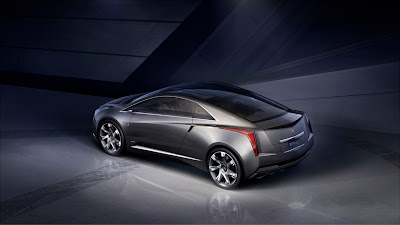
2009 Cadillac Converj Concept ViewA thermally managed battery pack contains more than 220 lithium-ion cells that provide the primary power to drive the Converj electrically up to 40 miles without using fuel or producing tailpipe emissions. The battery is integrated into the Converj’s chassis and stores electricity from the grid when the vehicle is plugged in. It takes less than three hours to recharge the battery at 240V, or about eight hours from a 120V outlet.

When the battery’s energy is low, the Converj seamlessly switches to extended-range mode. During this secondary level of operation, electricity needed to power the vehicle is created on-board by a flex-fuel-powered engine that operates much like a home generator to create electricity. The engine-generator ensures a constant supply of power for hundreds of miles until the car is refueled or plugged in to recharge the battery. This extended-range mode eliminates the range anxiety that comes with driving pure electric vehicles that offer no backup power when the battery charge is low.

2009 Cadillac Converj Concept PhotoWhether in electric or extended-range mode, the Converj is propelled all the time by an electric drive unit. It converts electrical energy from the battery or the engine-generator into mechanical energy to drive the front wheels. It also delivers 273 lb.-ft. (370 Nm) of instant torque, for a quick launch, and 120 kW of power. The top speed is 100 mph.

There is no compromise in vehicle performance in either mode of operation. To enhance the ride feel, the Converj also features GM’s Magnetic Ride Control; and for even greater efficiency, energy during braking is captured and stored in the battery.

Pure Cadillac design
There’s no mistaking the Converj for anything but a Cadillac, according to Lutz. “An aggressive, forward-leaning profile hints at a new, progressive theme and proportion in Cadillac’s design evolution,” he says. “The new proportion showcases a uniquely shaped, modern vision of a personal luxury 2+2.”

The overall shape is reinforced by a prominent, sweeping body line with large, 21-inch (front) and 22-inch (rear) wheels pushed to the edges of the body. The Converj exterior is painted a dark silver tri-coat that GM designers dubbed “Reaction.”

2009 Cadillac Converj Concept Show CarAn all-glass roof incorporates solar panels that help offset power drain from the vehicle’s accessories. Additionally, several aerodynamic and design efficiencies were incorporated to enhance the driving range, including:
A full under-vehicle cover (belly pan)
Minimal grille openings that reduce drag at the front of the vehicle
Low-profile rearview cameras replace conventional outside mirrors to reduce drag
Wheels are shaped to push air outward for smoother body side airflow

The Converj also incorporates vertical headlamp and taillamp elements, with light pipe technology.

“Vertical lamps are Cadillac signatures and the Converj builds on the brand’s light pipe technology with bolder light emitting diode (LED) and high-intensity discharge elements front and rear,” said Clay Dean, global design director for Cadillac. “There is also a unique daylight light ’spear’ at the top of the headlamps.”

2009 Cadillac Converj Concept InteriorLuxury meets technology inside
The Converj’s interior has advanced features and luxurious appointments blending efficiency and environmental consciousness. The 2+2 configuration is trimmed in contrasting Winter White synthetic suede – including the top of the instrument panel – and Midnight Black leather, with polished aluminum and wood grain accents. Renewable materials are used throughout such as wool-blend carpeting, a headliner made from silk, suede made from post-industrial content and more.

A technologically advanced driver center increases efficiency and reduces the draw on the battery. Features include:
New, organic light-emitting diode technology used on reconfigurable instrument cluster
Touch-screen navigation, climate, center-stack controls and audio systems
Adjustable, overhead white ambient lighting
Unique “power on” sequence featuring blue-lit console graphics
Screen displays for features including regenerative braking, battery charge level and power output
No inside rearview or outside mirrors; cameras provide surrounding images on a screen placed high on the instrument panel for a full, panoramic view
Push-button ignition and power-folding front seats

General Motors Corp. (NYSE: GM), the world’s largest automaker, has been the annual global industry sales leader for 77 years. Founded in 1908, GM today employs about 252,000 people around the world. With global headquarters in Detroit, GM manufactures its cars and trucks in 34 countries. In 2007, nearly 9.37 million GM cars and trucks were sold globally under the following brands: Buick, Cadillac, Chevrolet, GMC, GM Daewoo, Holden, HUMMER, Opel, Pontiac, Saab, Saturn, Vauxhall and Wuling. GM’s OnStar subsidiary is the industry leader in vehicle safety, security and information services.

SPECIFICATIONS
General
Vehicle type:
2-door, front-wheel-drive 2+2 coupe
Category:
extended-range electric vehicle
Chassis:
independent McPherson struts, front magnetic ride, compound crank twist axle rear, four-wheel disc brakes, full regenerative brakes to maximize energy capture, electric power-assist steering
Seating capacity:
four

Performance
Top speed (mph / km/h):
100 / 161
EV range, city and highway (miles):
Up to 40, based on EPA cycle

Dimensions
Wheelbase (in / mm):
108 / 2742
Length (in / mm):
182 / 4620
Width (in / mm):
74 / 1883
Height (in / mm):
55 / 1386

Battery system
Type:
lithium-ion (w/ liquid-controlled thermal management system)
Energy (kWh):
16
Charge time:
Less than 3 hours at 240V/8 hours at 120V

Electric drive unit
Power (kW):
120
Torque (lb-ft / Nm):
273 / 370

Exterior
Tire size:
specially developed low rolling resistance tires on 21- and 22-inch forged aluminum wheels


Thursday, November 4, 2010

2011 Cadillac DTS Review


Eras end. Driven by changing tastes and the aging of customers, Cadillac will stop making and selling the big DTS sedan (the modern-day version of the Sedan DeVille) at the end of the 2011 model year.  It will be replaced by the XTS, a car that will almost certainly be targeted to the tastes of Baby Boom luxury car buyers...and thus, at Lexus, Audi and BMW.


It's easy for Boomers to ignore and even ridicule the DTS, a car you're most likely to find in retirement communities, parking lots of restaurants serving the Early Bird special dinners and the occasional rental fleet.


But it's also wrong.


At a base price of $46,680, Cadillac's biggest sedan is $3500 less than the BMW 335is coupe. Apples and oranges, you say? You're right. Let's put the DTS against the least-expensive big Bimmer, the 740i sedan.


The Cadillac is $24,000 less. It has more room, costs less to insure, maintain and license and the highway fuel economy difference (23 mpg for the Cadillac, 25 for the BMW) is negligible.


So what's it like to drive? I hadn't had the opportunity in 7 years (even GM's press fleet folks have been treating the DTS like a stepchild), so I rounded one up through alternative sources for a week.  No, it's not meant for blasting through winding mountain roads (newsflash: neither is any Lexus save the IS-F).


What it is is quiet, smooth, responsive, and, given its size and lack of cutting-edge handling hardware, remarkably agile.  The people who've eagerly shelled out $65K for Escalades but wouldn't give a DTS the time of day would think they're driving a sport sedan by comparison. They'd also find they and their passengers are as or more comfortable and they could make a nice dent in the power bill with the money they save on gasoline.


Something I learned programming popular music radio back in the day: There is such a thing as out-hipping yourself, walking away from things of value to a mass audience in the pursuit of image. A week in the DTS has me strongly suspecting that we'll miss it once it's gone.

Sunday, October 10, 2010

Sunday, August 1, 2010

Cadillac CTS Coupe Concept, 2008

Cadillac CTS Coupe Concept, 2008


The Cadillac CTS Coupe takes Cadillac's acclaimed Art and Science design language and adds more of both. More expressive, more technical and very personal, the Cadillac CTS Coupe extends the dramatic design of its sedan predecessor with all-new sculpted bodywork aft of the front fenders.

The Cadillac CTS Coupe Concept has a classic 2+2 interior layout, highlighted by black leather and Alcantara microfiber trim that is complemented by yellow ochre-colored seat inserts and leather stitching. It is designed to accommodate a range of engines for the global luxury market, including Cadillac's popular 3.6L Direct Injection V-6, as well as a new 2.9L turbo-diesel currently in development.

Generated from the spark of the CTS design team's imagination, the Cadillac CTS Coupe casts a profile unlike anything else on the road. Its fast-rake styling - it has the same wheelbase as the CTS, but an overall height that is approximately four inches (101 mm) shorter - blends with hand-sculpted bodywork that bulges around the wheels, giving the vehicle a ready-to-pounce stance that is dramatic, powerful and sleek.
A design gem
Among the Cadillac CTS Coupe Concept's signature design cues are a number of elements that suggest the look of a carefully cut diamond - particularly at the rear. These elements are seen in everything from the chrome header above the rear license plate holder to the indents that comprise the basic form of the rear fascia.
  • Based on the sedan, the Cadillac CTS Coupe shares only the instrument panel, console, headlamps, front fenders and grille with the production model. Unique elements:
  • Classic hardtop styling, with no B-pillar
  • CTS production windshield laid at a faster angle to create a sleeker profile
  • Chrome, split seven-spoke wheel design; 20-inch front wheels and 21-inch rear wheels
  • Sculpted lower front fascia with unique brake-cooling vents
  • Slim-profile outside mirrors
  • XLR-type hidden door handles with proximity remote opening
  • Unique front fender vents
  • Diamond-cut rear fascia with mesh lower grilles and center-outlet exhaust
  • Taillamps with a subtle fin profile and are highlighted with LED lighting technology with light pipes
  • Rear spoiler integrated into the center high-mounted stop lamp
  • Sculpted roof-mounted antenna for OnStar, XM Satellite Radio, etc.
The surfaces of Cadillac CTS Coupe Concept are complex, inviting careful inspection. The rear fenders, for example, were sculpted by hand in the design studio until they provided a perfect, muscular form that wrapped tightly over the wheels. At the top, the rear fenders are beveled - owing to the diamond-cut theme - and become part of a horizontal plane that runs from the leading edge of the tail lamps and merges into the roof.

Personal passenger environment
A classic 2+2 interior environment enhances the Cadillac CTS Coupe's personal feel. It shares the hand cut-and-sewn instrument panel and center console with the CTS, but features unique front and rear seats, a continuous console running between the front and rear seats, and custom door panels.

Black microfiber fabric covers the front armrest, as well as an armrest located between the rear seats. The armrests are part of a continuous console that stretches from the instrument panel to rear seats. Carbon-fiber trim accents the console. The interior also features ambient lighting throughout, creating a distinctive environment at night.

Performance-bred powertrain and suspension systems
As is the case with its design, the Cadillac CTS Coupe extends the acclaimed capabilities of the sedan in terms of performance technology. This includes the capability to support a broad engine range of gasoline and diesel engines.

The Cadillac CTS Coupe, of course, ascertains the sedan's 3.6L V-6 engines, including the 304-horsepower (227 kW) Direct Injection power plant. The Coupe Concept also is designed for a new 2.9L turbo-diesel being developed for international markets. This new engine, tailored for use in the CTS, will deliver an estimated 250 horsepower (184 kW) and 406 lb.-ft. of torque (550 Nm).

A 6-speed manual transmission backs the engine, sending torque to an independently sprung rear axle. The CTS Coupe's sport-tuned suspension gives it a slightly lower ride height than a production CTS - a look enhanced by the car's rakish shape and large, 20-inch front and 21-inch rear wheels.

CADILLAC CTS Coupe CONCEPT SPECIFICATIONS
  • Vehicle type: two-door, four-passenger rear-wheel-drive coupe
  • Wheelbase (in / mm): 113.4 / 2880
  • Length (in / mm): 187 / 4750
  • Width (in / mm): 73.6 / 1870
  • Height (in / mm): 54.7 / 1390
  • Track (in / mm): 61.8 / 1570 (front); 62 / 1575 (rear)
  • Powertrain: 2.9L turbo-diesel; six-speed manual transmission
  • Suspension: four-wheel independent: MacPherson strut front; multilink rear, progressive rate coil springs, monotube shock absorbers
  • Brakes: four-wheel disc; crossed-drilled rotors
  • Wheels: cast aluminum; 20-in front, 21-in rear

Cadillac CTS, 2008

Cadillac CTS, 2008


Aggressive and elegant, expressive and sophisticated, the 2008 Cadillac CTS exudes a dramatic design presence. This all-new luxury sedan not only pushes Cadillac's acclaimed design theme higher, it aims to redraw the boundaries of the normally conservative luxury sedan category. Inside and out, the 2008 CTS contradicts many traditional design conventions. CTS' design expresses its serious performance intent, yet also is more elegant and luxurious. It's a sedan in the heart of the luxury market, yet reaches for the charisma of a sports car. CTS is thoroughly new and contemporary, even while it evokes the grandeur of classic Cadillac cars.

Since the inception of the first-generation car in 2002, CTS is about trend-setting design. The edgy form of the CTS initially created controversy. But from the moment it hit the market, its design also attracted lots of buyers, with design often noted as a top reason for purchase. The all-new 2008 edition extends that edgy and contemporary character, with an injection of elegance.

On the exterior, there's no mistaking the five-passenger sedan's stronger stance, thanks to a two-inch wider track. Additionally, the overall shape of the CTS features a faster profile with more rake, coupled with surfaces that add elegance and grace. Borrowing from Cadillac's legendary heritage, design cues include vertically shaped headlights and taillamps, signature light emitting diode (LED) exterior lighting, horizontal spline lines and its dihedral-shaped hood, all highlighted with many bright and jeweled accents.

Exterior: sporty sophistication meets substance
Coupled with a new overall shape, the most evolutionary dimension of the 2008 CTS comes in the form of a two-inch wider track as a result of the addition of the new, optional all-wheel-drive configuration. The wider stance gives the new model a more planted, capable and well-grounded appearance that's exemplified by much tighter tire-to-fender relationships.

The wider stance also enables more tumblehome - the vehicle sides are sculpted inward - delivering an appearance of rear-wheel-drive performance with a lower roof line, without compromising headroom or a roomy interior.

Seven-spoke, 17-inch wheels or available nine-spoke, 18-inch wheels surround larger high-performance brake calipers and rotors. Both painted and machined finishes are available for the standard 17-inch wheels. The larger, 18-inch wheels are available in a premium multicoat finish or a high-polish finish.
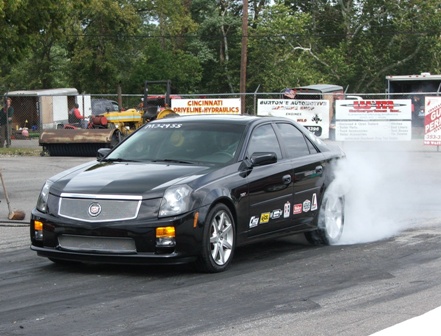
Inspired by Cadillac's landmark Sixteen concept car, the CTS front appearance is immediately recognizable, yet also is new. The large, chrome dual-textured grille is significantly more vertical in shape, and is both aggressive and intricate. A large center-positioned wreath and crest add to the three-dimensional face. The front fascia is balanced with vertically stacked headlamps with bright bezels stacked in a staircase-like array. The lower air intake is flanked on both sides with fog lamps and brake duct intakes.

Side air extractors located forward of the front doors are a modern homage to Cadillac's grand heritage. Additional bright details include chrome molding surrounding the side windows, and three-inch chromed exhaust outlets.

Dimensionally, the 2008 CTS is 191.6 inches (4766 mm) long, 72.5 inches (1841 mm) wide and 58 inches (1472 mm) in height. Wheelbase is 113.4 inches (2880 mm) with a front/rear track of 61.8 / 62.0 inches (1575 / 1585 mm).

Interior: performance and elegance combine
The 2008 CTS represents a new design theme for Cadillac interiors, emphasizing technical precision with elegant, hand-crafted details. Dramatically different from the original, the interior design is decidedly more upscale, with added ornamentation, luxury and attention to detail. Strict attention to packaging, premium materials, surface development and comfort combine to meet the discriminating tastes of luxury performance sedan buyers.

New 3.6L V-6 VVT, six-speed automatic join powertrain lineup
The 2008 Cadillac CTS features GM's new 3.6L direct-injection V-6 VVT engine, delivering an estimated 300 horsepower (223 kW) and 270 lb.-ft. (366 Nm) of torque. This new powerplant is a compelling mixture of power, smoothness, efficiency and technical sophistication.

The 3.6L direct-injection engine will be the top-level engine option for the 2008 CTS, joining the existing 2.8L V-6 and 3.6L V-6. Designed to operate with regular unleaded gasoline, the new 3.6-liter direct-injection V-6 produces power similar to many V-8 engines, but with much better fuel economy. With direct injection, fuel is delivered directly to the combustion chamber to create a more complete burn of the air/fuel mixture. Less fuel is required to produce the equivalent horsepower, especially at normal cruising speeds, of a conventional port-injection combustion system.

Chassis enhancements include all wheel drive, globally tested suspension
The 2008 CTS features a greatly revised chassis featuring a two-inch wider track and the application of all-wheel drive. The front track is increased to 61.8 inches (1569 mm), and rear track is now 62.0 inches (1575 mm). Wheelbase remains at 113.4 inches (2880 mm).

Cadillac engineers have designed and developed new geometry for both the independent short/long arm front suspension and the multilink rear suspension. Engineers implemented numerous tweaks and revisions to the suspension using extensive computer modeling, combined with development driving of prototype cars on roads all over the world, but mostly in North America, Europe and China .

Thursday, March 25, 2010

Cadillac BLS Wagon, 2008

Cadillac BLS Wagon 2008

Cadillac reinforced its commitment to grow its brand in Europe by announcing it will add the BLS Wagon to its portfolio later this year.

The BLS Wagon also features jewel-like headlamps, fog lamps integrated into the body-colored bumper and a wide air intake below the grille. A narrow chrome strip runs along the side windows and the latest LED technology is used in the center high-mounted stop lamp, which is prominently positioned in the rear spoiler. Vertical taillamps, another Cadillac hallmark, play a prominent role in defining the elegant rear proportions of the BLS Wagon.

Luxurious, flexible interior and state-of-the-art infotainment systems
The BLS Wagon interior is highlighted by a three-spoke leather steering wheel and an analog clock in the center stack. The circular instruments have white numerals and red needles on a black background.

Flexibility and versatility define the rear seats and cargo area, which are designed to support a wide variety of luxury and leisure interests.

State-of-the-art infotainment systems include high-quality audio units from American sound specialist Bose, among others; a DVD navigation system with touch-screen operation; a Bluetooth-enabled cell phone system with a hands-free kit; and remote controls on the steering wheel.

Turbocharged diesel and turbocharged gasoline engines
The front-wheel-drive BLS Wagon is offered with a turbo-diesel and three turbocharged gasoline engines. The 1.9L four-cylinder diesel engine, with common-rail direct-injection technology, is fitted with a maintenance-free particulate filter and delivers 110 kW (150 hp) of power. The range of gasoline engines includes two 2.0L four-cylinder versions (129 kW / 175 hp and 154 kW / 210 hp), and a high-tech, 2.8L V-6 (188 kW / 255 hp) that features a twin-scroll turbocharger and variable phasing of the intake camshafts.

The BLS Wagon has 6-speed manual transmissions and five- or six-speed automatic transmissions, depending on engine. For BLS models equipped with an automatic transmission, a standard Sport Mode button allows the driver to select a sportier transmission shift pattern.

Comfort and driving dynamics
The chassis, which features MacPherson struts in front and a four-link rear axle, is designed to provide the agility customers expect from a luxury wagon. The chassis tuning ensures dynamic handling performance without compromising comfort and load capacity.